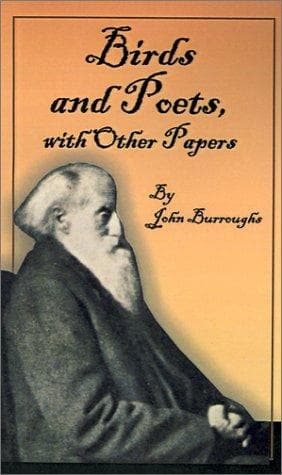
Birds and Poets : with Other PapersBurroughs, John
History
Birds and Poets : with Other Papers
Burroughs, John
American essays -- 19th century; Birds; Natural history -- Outdoor books; Nature
"This poet, though he lived apart,
Moved by his hospitable heart,
Sped, when I passed his sylvan fort,
To do the honors of his court,
As fits a feathered lord of land;
Flew near, with soft wing grazed my hands
Hopped on the bough, then darting low,
Prints his small impress on the snow,
Shows feats of his gymnastic play,
Head downward, clinging to the spray.
"Here was this atom in full breath,
Hurling defiance at vast death;
This scrap of valor just for play
Fronts the north-wind in waistcoat gray,
As if to shame my weak behavior;
I greeted loud my little savior,
'You pet! what dost here? and what for?
In these woods, thy small Labrador,
At this pinch, wee San Salvador!
What fire burns in that little chest,
So frolic, stout, and self-possest?
Henceforth I wear no stripe but thine;
Ashes and jet all hues outshine.
Why are not diamonds black and gray,
To ape thy dare-devil array?
And I affirm, the spacious North
Exists to draw thy virtue forth.
I think no virtue goes with size;
The reason of all cowardice
Is, that men are overgrown,
And, to be valiant, must come down
To the titmouse dimension.'
. . . . . . . .
"I think old Caesar must have heard
In northern Gaul my dauntless bird,
And, echoed in some frosty wold,
Borrowed thy battle-numbers bold.
And I will write our annals new
And thank thee for a better clew.
I, who dreamed not when I came here
To find the antidote of fear,
Now hear thee say in Roman key,
_Poean! Veni, vidi, vici."_
A late bird-poem, and a good one of its kind, is Celia Thaxter's
"Sandpiper," which recalls Bryant's "Water-Fowl" in its successful
rendering of the spirit and atmosphere of the scene, and the
distinctness with which the lone bird, flitting along the beach, is
brought before the mind. It is a woman's or a feminine poem, as Bryant's
is characteristically a man's.
The sentiment or feeling awakened by any of the aquatic fowls is
preeminently one of loneliness. The wood duck which your approach starts
from the pond or the marsh, the loon neighing down out of the April
sky, the wild goose, the curlew, the stork, the bittern, the sandpiper,
awaken quite a different train of emotions from those awakened by
the land-birds. They all have clinging to them some reminiscence and
suggestion of the sea. Their cries echo its wildness and desolation;
their wings are the shape of its billows.
Public-domain text, read in full here on John Shaqi.
Reviews
Reviews
No reviews yet
Be the first to share your thoughts on this work.
Join the Discussion
Join the discussion
Sign in to leave a comment or review.
Sign InorCreate an account