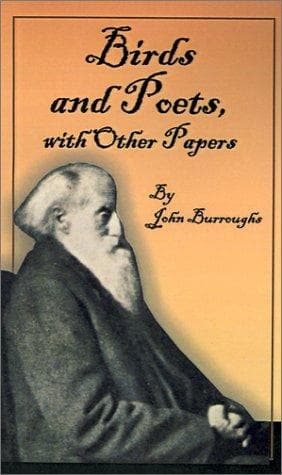
Birds and Poets : with Other PapersBurroughs, John
History
Birds and Poets : with Other Papers
Burroughs, John
American essays -- 19th century; Birds; Natural history -- Outdoor books; Nature
So had Wilson, though perhaps not in as large a measure; yet he took
fire as only a poet can. While making a journey on foot to Philadelphia,
shortly after landing in this country, he caught sight of the red-headed
woodpecker flitting among the trees,--a bird that shows like a
tricolored scarf among the foliage,--and it so kindled his enthusiasm
that his life was devoted to the pursuit of the birds from that day. It
was a lucky hit. Wilson had already set up as a poet in Scotland, and
was still fermenting when the bird met his eye and suggested to his soul
a new outlet for its enthusiasm.
The very idea of a bird is a symbol and a suggestion to the poet. A
bird seems to be at the top of the scale, so vehement and intense is
his life,--large-brained, large-lunged, hot, ecstatic, his frame charged
with buoyancy and his heart with song. The beautiful vagabonds, endowed
with every grace, masters of all climes, and knowing no bounds,--how
many human aspirations are realized in their free, holiday lives, and
how many suggestions to the poet in their flight and song!
Indeed, is not the bird the original type and teacher of the poet, and
do we not demand of the human lark or thrush that he "shake out his
carols" in the same free and spontaneous manner as his winged
prototype? Kingsley has shown how surely the old minnesingers and early
ballad-writers have learned of the birds, taking their key-note from the
blackbird, or the wood-lark, or the throstle, and giving utterance to a
melody as simple and unstudied. Such things as the following were surely
caught from the fields or the woods:--
"She sat down below a thorn,
Fine flowers in the valley,
And there has she her sweet babe borne,
And the green leaves they grow rarely."
Or the best lyric pieces, how like they are to certain
bird-songs!--clear, ringing, ecstatic, and suggesting that challenge
and triumph which the outpouring of the male bird contains. (Is not
the genuine singing, lyrical quality essentially masculine?) Keats and
Shelley, perhaps more notably than any other English poets, have the
bird organization and the piercing wild-bird cry. This, of course,
is not saying that they are the greatest poets, but that they have
preeminently the sharp semi-tones of the sparrows and the larks.
But when the general reader thinks of the birds of the poets, he
very naturally calls to mind the renowned birds, the lark and the
nightingale, Old World melodists, embalmed in Old World poetry, but
occasionally appearing on these shores, transported in the verse of some
callow singer.
Public-domain text, read in full here on John Shaqi.
Reviews
Reviews
No reviews yet
Be the first to share your thoughts on this work.
Join the Discussion
Join the discussion
Sign in to leave a comment or review.
Sign InorCreate an account