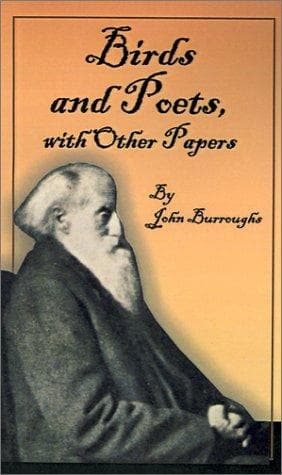
Birds and Poets : with Other PapersBurroughs, John
History
Birds and Poets : with Other Papers
Burroughs, John
American essays -- 19th century; Birds; Natural history -- Outdoor books; Nature
The very oldest poets, the towering antique bards, seem to make little
mention of the song-birds. They loved better the soaring, swooping birds
of prey, the eagle, the ominous birds, the vultures, the storks and
cranes, or the clamorous sea-birds and the screaming hawks. These
suited better the rugged, warlike character of the times and the simple,
powerful souls of the singers themselves. Homer must have heard the
twittering of the swallows, the cry of the plover, the voice of the
turtle, and the warble of the nightingale; but they were not adequate
symbols to express what he felt or to adorn his theme. Aeschylus saw in
the eagle "the dog of Jove," and his verse cuts like a sword with such a
conception.
It is not because the old bards were less as poets, but that they were
more as men. To strong, susceptible characters, the music of nature is
not confined to sweet sounds. The defiant scream of the hawk circling
aloft, the wild whinny of the loon, the whooping of the crane, the
booming of the bittern, the vulpine bark of the eagle, the loud
trumpeting of the migratory geese sounding down out of the midnight sky;
or by the seashore, the coast of New Jersey or Long Island, the wild
crooning of the flocks of gulls, repeated, continued by the hour,
swirling sharp and shrill, rising and falling like the wind in a storm,
as they circle above the beach or dip to the dash of the waves,--are
much more welcome in certain moods than any and all mere bird-melodies,
in keeping as they are with the shaggy and untamed features of ocean
and woods, and suggesting something like the Richard Wagner music in the
ornithological orchestra.
"Nor these alone whose notes
Nice-fingered art must emulate in vain,
But cawing rooks, and kites that swim sublime
In still repeated circles, screaming loud,
The jay, the pie, and even the boding owl,
That hails the rising moon, have charms for me,"
says Cowper. "I never hear," says Burns in one of his letters, "the
loud, solitary whistle of the curlew in a summer noon, or the wild
mixing cadence of a troop of gray plovers in an autumnal morning,
without feeling an elevation of soul like the enthusiasm of devotion or
poetry."
Even the Greek minor poets, the swarm of them that are represented in
the Greek Anthology, rarely make affectionate mention of the birds,
except perhaps Sappho, whom Ben Jonson makes speak of the nightingale
as--
"The dear glad angel of the spring."
Public-domain text, read in full here on John Shaqi.
Reviews
Reviews
No reviews yet
Be the first to share your thoughts on this work.
Join the Discussion
Join the discussion
Sign in to leave a comment or review.
Sign InorCreate an account