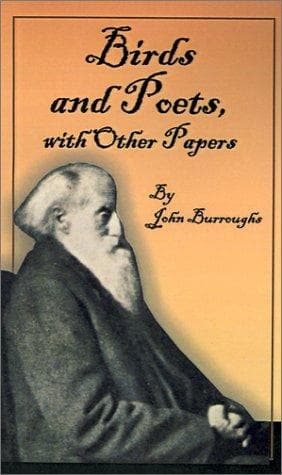
Birds and Poets : with Other PapersBurroughs, John
History
Birds and Poets : with Other Papers
Burroughs, John
American essays -- 19th century; Birds; Natural history -- Outdoor books; Nature
I heard a great man say that he could see how much of the theology
of the day would fall before the standard of him who had got even the
insects. And let any one set about studying these creatures carefully,
and he will see the force of the remark. We learn the tremendous
doctrine of metamorphosis from the insect world; and have not the bee
and the ant taught man wisdom from the first? I was highly edified
the past summer by observing the ways and doings of a colony of black
hornets that established themselves under one of the projecting gables
of my house. This hornet has the reputation of being a very ugly
customer, but I found it no trouble to live on the most friendly terms
with her. She was as little disposed to quarrel as I was. She is indeed
the eagle among hornets, and very noble and dignified in her bearing.
She used to come freely into the house and prey upon the flies. You
would hear that deep, mellow hum, and see the black falcon poising on
wing, or striking here and there at the flies, that scattered on her
approach like chickens before a hawk. When she had caught one, she would
alight upon some object and proceed to dress and draw her game. The
wings were sheared off, the legs cut away, the bristles trimmed, then
the body thoroughly bruised and broken. When the work was completed,
the fly was rolled up into a small pellet, and with it under her arm
the hornet flew to her nest, where no doubt in due time it was properly
served up on the royal board. Every dinner inside these paper walls is a
state dinner, for the queen is always present.
I used to mount the ladder to within two or three feet of the nest
and observe the proceedings. I at first thought the workshop must be
inside,--a place where the pulp was mixed, and perhaps treated with
chemicals; for each hornet, when she came with her burden of materials,
passed into the nest, and then, after a few moments, emerged again and
crawled to the place of building. But I one day stopped up the entrance
with some cotton, when no one happened to be on guard, and then observed
that, when the loaded hornet could not get inside, she, after some
deliberation, proceeded to the unfinished part and went forward with her
work. Hence I inferred that maybe the hornet went inside to report and
to receive orders, or possibly to surrender her material into fresh
hands. Her career when away from the nest is beset with dangers; the
colony is never large, and the safe return of every hornet is no doubt a
matter of solicitude to the royal mother.
The hornet was the first paper-maker, and holds the original patent. The
paper it makes is about like that of the newspaper; nearly as firm, and
made of essentially the same material,--woody fibres scraped from old
rails and boards. And there is news on it, too, if one could make out
the characters.
Public-domain text, read in full here on John Shaqi.
Reviews
Reviews
No reviews yet
Be the first to share your thoughts on this work.
Join the Discussion
Join the discussion
Sign in to leave a comment or review.
Sign InorCreate an account