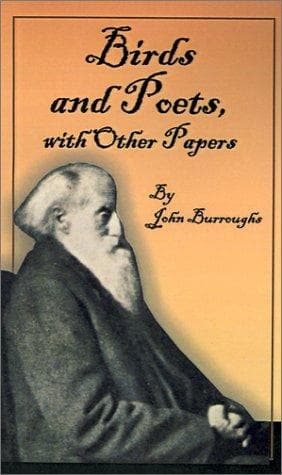
Birds and Poets : with Other PapersBurroughs, John
History
Birds and Poets : with Other Papers
Burroughs, John
American essays -- 19th century; Birds; Natural history -- Outdoor books; Nature
It is well to let down our metropolitan pride a little. Man thinks
himself at the top, and that the immense display and prodigality of
Nature are for him. But they are no more for him than they are for
the birds and beasts, and he is no more at the top than they are. He
appeared upon the stage when the play had advanced to a certain point,
and he will disappear from the stage when the play has reached another
point, and the great drama will go on without him. The geological ages,
the convulsions and parturition throes of the globe, were to bring him
forth no more than the beetles. Is not all this wealth of the seasons,
these solar and sidereal influences, this depth and vitality and
internal fire, these seas, and rivers, and oceans, and atmospheric
currents, as necessary to the life of the ants and worms we tread under
foot as to our own? And does the sun shine for me any more than for yon
butterfly? What I mean to say is, we cannot put our finger upon this
or that and say, Here is the end of Nature. The Infinite cannot be
measured. The plan of Nature is so immense,--but she has no plan,
no scheme, but to go on and on forever. What is size, what is time,
distance, to the Infinite? Nothing. The Infinite knows no time, no
space, no great, no small, no beginning, no end.
I sometimes think that the earth and the worlds are a kind of nervous
ganglia in an organization of which we can form no conception, or less
even than that. If one of the globules of blood that circulate in our
veins were magnified enough million times, we might see a globe teeming
with life and power. Such is this earth of ours, coursing in the veins
of the Infinite. Size is only relative, and the imagination finds no end
to the series either way.
III
Looking out of the car window one day, I saw the pretty and unusual
sight of an eagle sitting upon the ice in the river, surrounded by half
a dozen or more crows. The crows appeared as if looking up to the
noble bird and attending his movements. "Are those its young?" asked a
gentleman by my side. How much did that man know--not about eagles,
but about Nature? If he had been familiar with geese or hens, or with
donkeys, he would not have asked that question. The ancients had an
axiom that he who knew one truth knew all truths; so much else becomes
knowable when one vital fact is thoroughly known. You have a key, a
standard, and cannot be deceived. Chemistry, geology, astronomy, natural
history, all admit one to the same measureless interiors.
Public-domain text, read in full here on John Shaqi.
Reviews
Reviews
No reviews yet
Be the first to share your thoughts on this work.
Join the Discussion
Join the discussion
Sign in to leave a comment or review.
Sign InorCreate an account