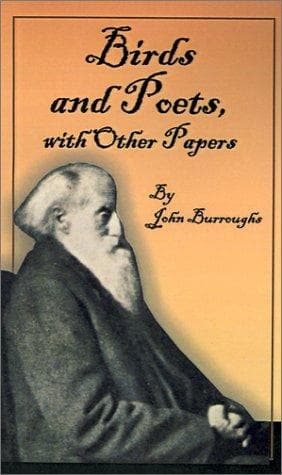
Birds and Poets : with Other PapersBurroughs, John
History
Birds and Poets : with Other Papers
Burroughs, John
American essays -- 19th century; Birds; Natural history -- Outdoor books; Nature
Notwithstanding what I have elsewhere said about the desolation of snow,
when one looks closely it is little more than a thin veil after all, and
takes and repeats the form of whatever it covers. Every path through
the fields is just as plain as before. On every hand the ground sends
tokens, and the curves and slopes are not of the snow, but of the earth
beneath. In like manner the rankest vegetation hides the ground less
than we think. Looking across a wide valley in the month of July, I have
noted that the fields, except the meadows, had a ruddy tinge, and that
corn, which near at hand seemed to completely envelop the soil, at that
distance gave only a slight shade of green. The color of the ground
everywhere predominated, and I doubt not that, if we could see the earth
from a point sufficiently removed, as from the moon, its ruddy hue, like
that of Mars, would alone be visible.
What is a man but a miniature earth, with many disguises in the way of
manners, possessions, dissemblances? Yet through all--through all the
work of his hands and all the thoughts of his mind--how surely the
ground quality of him, the fundamental hue, whether it be this or that,
makes itself felt and is alone important!
XV
Men follow their noses, it is said. I have wondered why the Greek did
not follow his nose in architecture,--did not copy those arches that
spring from it as from a pier, and support his brow,--but always and
everywhere used the post and the lintel. There was something in that
face that has never reappeared in the human countenance. I am thinking
especially of that straight, strong profile. Is it really godlike, or
is this impression the result of association? But any suggestion or
reminiscence of it in the modern face at once gives one the idea of
strength. It is a face strong in the loins, or it suggests a high,
elastic instep. It is the face of order and proportion. Those arches are
the symbols of law and self-control. The point of greatest interest is
the union of the nose with the brow,--that strong, high embankment;
it makes the bridge from the ideal to the real sure and easy. All the
Greek's ideas passed readily into form. In the modern face the arches
are more or less crushed, and the nose is severed from the brow,--hence
the abstract and the analytic; hence the preponderance of the
speculative intellect over creative power.
XVI
Public-domain text, read in full here on John Shaqi.
Reviews
Reviews
No reviews yet
Be the first to share your thoughts on this work.
Join the Discussion
Join the discussion
Sign in to leave a comment or review.
Sign InorCreate an account