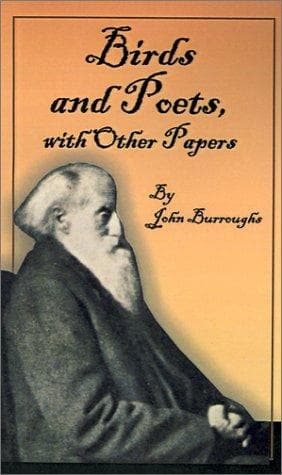
Birds and Poets : with Other PapersBurroughs, John
History
Birds and Poets : with Other Papers
Burroughs, John
American essays -- 19th century; Birds; Natural history -- Outdoor books; Nature
Not so with the birds. The bird has the human eye in its clearness, its
power, and its supremacy over the other senses. How acute their sense
of smell may be is uncertain; their hearing is sharp enough, but their
vision is the most remarkable. A crow or a hawk, or any of the larger
birds, will not mistake you for a stump or a rock, stand you never so
still amid the bushes. But they cannot separate you from your horse or
team. A hawk reads a man on horseback as one animal, and reads it as a
horse. None of the sharp-scented animals could be thus deceived.
The bird has man's brain also in its size. The brain of a song-bird is
even much larger in proportion than that of the greatest human monarch,
and its life is correspondingly intense and high-strung. But the bird's
eye is superficial. It is on the outside of his head. It is round, that
it may take in a full circle at a glance.
All the quadrupeds emphasize their direct forward gaze by a
corresponding movement of the ears, as if to supplement and aid one
sense with another. But man's eye seldom needs the confirmation of
his ear, while it is so set, and his head so poised, that his look is
forcible and pointed without being thus seconded.
XIII
I once saw a cow that had lost her cud. How forlorn and desolate and
sick at heart that cow looked! No more rumination, no more of that
second and finer mastication, no more of that sweet and juicy reverie
under the spreading trees, or in the stall. Then the farmer took an
elder and scraped the bark and put something with it, and made the cow a
cud, and, after due waiting, the experiment took, a response came back,
and the mysterious machinery was once more in motion, and the cow was
herself again.
Have you, O poet, or essayist, or story-writer, never lost your cud,
and wandered about days and weeks without being able to start a single
thought or an image that tasted good,--your literary appetite dull or
all gone, and the conviction daily growing that it was all over with you
in that direction? A little elder-bark, something fresh and bitter from
the woods, is about the best thing you can take.
XIV
Public-domain text, read in full here on John Shaqi.
Reviews
Reviews
No reviews yet
Be the first to share your thoughts on this work.
Join the Discussion
Join the discussion
Sign in to leave a comment or review.
Sign InorCreate an account