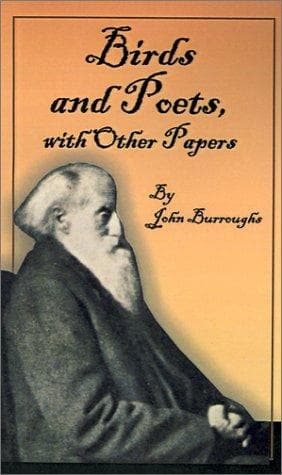
Birds and Poets : with Other PapersBurroughs, John
History
Birds and Poets : with Other Papers
Burroughs, John
American essays -- 19th century; Birds; Natural history -- Outdoor books; Nature
One reason why dead birds and animals are so rarely found is, that on
the approach of death their instinct prompts them to creep away in some
hole or under some cover, where they will be least liable to fall a prey
to their natural enemies. It is doubtful if any of the game-birds, like
the pigeon and grouse, ever die of old age, or the semi-game-birds, like
the bobolink, or the "century living" crow; but in what other form can
death overtake the hummingbird, or even the swift and the barn swallow?
Such are true birds of the air; they may be occasionally lost at sea
during their migrations, but, so far as I know, they are not preyed upon
by any other species.
The valley of the Hudson, I find, forms a great natural highway for the
birds, as do doubtless the Connecticut, the Susquehanna, the Delaware,
and all other large water-courses running north and south. The birds
love an easy way, and in the valleys of the rivers they find a road
already graded for them; and they abound more in such places throughout
the season than they do farther inland. The swarms of robins that come
to us in early spring are a delight to behold. In one of his poems
Emerson speaks of
"April's bird,
Blue-coated, flying before from tree to tree;"
but April's bird with me is the robin, brisk, vociferous, musical,
dotting every field, and larking it in every grove; he is as easily atop
at this season as the bobolink is a month or two later. The tints of
April are ruddy and brown,--the new furrow and the leafless trees,--and
these are the tints of its dominant bird.
From my dining-room window I look, or did look, out upon a long stretch
of smooth meadow, and as pretty a spring sight as I ever wish to behold
was this field, sprinkled all over with robins, their red breasts turned
toward the morning sun, or their pert forms sharply outlined against
lingering patches of snow. Every morning for weeks I had those robins
for breakfast; but what they had I never could find out.
After the leaves are out, and gayer colors come into fashion, the robin
takes a back seat. He goes to housekeeping in the old apple-tree, or,
what he likes better, the cherry-tree. A pair reared their domestic
altar (of mud and dry grass) in one of the latter trees, where I saw
much of them. The cock took it upon himself to keep the tree free of all
other robins during cherry time, and its branches were the scene of
some lively tussles every hour in the day. The innocent visitor would
scarcely alight before the jealous cock was upon him; but while he was
thrusting the intruder out at one side, a second would be coming in on
the other. He managed, however, to protect his cherries very well, but
had so little time to eat the fruit himself that we got fully our share.
Public-domain text, read in full here on John Shaqi.
Reviews
Reviews
No reviews yet
Be the first to share your thoughts on this work.
Join the Discussion
Join the discussion
Sign in to leave a comment or review.
Sign InorCreate an account