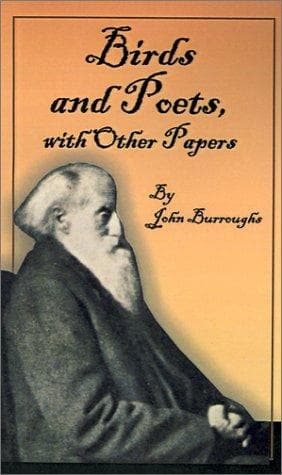
Birds and Poets : with Other PapersBurroughs, John
History
Birds and Poets : with Other Papers
Burroughs, John
American essays -- 19th century; Birds; Natural history -- Outdoor books; Nature
Keats's poem on the nightingale is doubtless more in the spirit of the
bird's strain than any other. It is less a description of the song and
more the song itself. Hood called the nightingale
"The sweet and plaintive Sappho of the dell."
I mention the nightingale only to point my remarks upon its American
rival, the famous mockingbird of the Southern States, which is also a
nightingale,--a night-singer,--and which no doubt excels the Old World
bird in the variety and compass of its powers. The two birds belong to
totally distinct families, there being no American species which answers
to the European nightingale, as there are that answer to the robin,
the cuckoo, the blackbird, and numerous others. Philomel has the color,
manners, and habits of a thrush,--our hermit thrush,--but it is not a
thrush at all, but a warbler. I gather from the books that its song is
protracted and full rather than melodious,--a capricious, long-continued
warble, doubling and redoubling, rising and falling, issuing from the
groves and the great gardens, and associated in the minds of the poets
with love and moonlight and the privacy of sequestered walks. All our
sympathies and attractions are with the bird, and we do not forget that
Arabia and Persia are there back of its song.
_Our_ nightingale has mainly the reputation of the caged bird, and
is famed mostly for its powers of mimicry, which are truly wonderful,
enabling the bird to exactly reproduce and even improve upon the notes
of almost any other songster. But in a state of freedom it has a song of
its own which is infinitely rich and various. It is a garrulous polyglot
when it chooses to be, and there is a dash of the clown and the buffoon
in its nature which too often flavors its whole performance, especially
in captivity; but in its native haunts, and when its love-passion is
upon it, the serious and even grand side of its character comes out. In
Alabama and Florida its song may be heard all through the sultry summer
night, at times low and plaintive, then full and strong. A friend of
Thoreau and a careful observer, who has resided in Florida, tells me
that this bird is a much more marvelous singer than it has the credit of
being. He describes a habit it has of singing on the wing on moonlight
nights, that would be worth going South to hear. Starting from a low
bush, it mounts in the air and continues its flight apparently to an
altitude of several hundred feet, remaining on the wing a number
of minutes, and pouring out its song with the utmost clearness and
abandon,--a slowly rising musical rocket that fills the night air with
harmonious sounds. Here are both the lark and nightingale in one; and if
poets were as plentiful down South as they are in New England, we should
have heard of this song long ago, and had it celebrated in appropriate
verse. But so far only one Southern poet, Wilde, has accredited the bird
this song. This he has done in the following admirable sonnet:--
Public-domain text, read in full here on John Shaqi.
Reviews
Reviews
No reviews yet
Be the first to share your thoughts on this work.
Join the Discussion
Join the discussion
Sign in to leave a comment or review.
Sign InorCreate an account