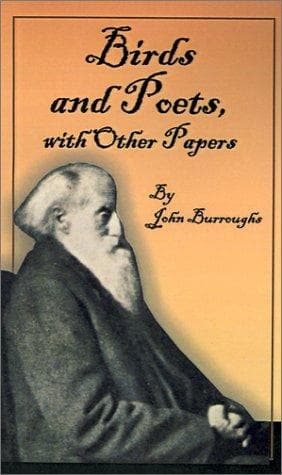
Birds and Poets : with Other PapersBurroughs, John
History
Birds and Poets : with Other Papers
Burroughs, John
American essays -- 19th century; Birds; Natural history -- Outdoor books; Nature
The cicada, the locust, and the grasshopper are often referred to, but
rarely by name any of the common birds. That Greek grasshopper must
have been a wonderful creature. He was a sacred object in Greece, and
is spoken of by the poets as a charming songster. What we would say of
birds the Greek said of this favorite insect. When Socrates and Phaedrus
came to the fountain shaded by the plane-tree, where they had their
famous discourse, Socrates said: "Observe the freshness of the spot, how
charming and very delightful it is, and how summer-like and shrill
it sounds from the choir of grasshoppers." One of the poets in the
Anthology finds a grasshopper struggling in a spider's web, which he
releases with the words:--
"Go safe and free with your sweet voice of song."
Another one makes the insect say to a rustic who had captured him:--
"Me, the Nymphs' wayside minstrel whose sweet note
O'er sultry hill is heard, and shady grove to float."
Still another sings how a grasshopper took the place of a broken string
on his lyre, and "filled the cadence due."
"For while six chords beneath my fingers cried,
He with his tuneful voice the seventh supplied;
The midday songster of the mountain set
His pastoral ditty to my canzonet;
And when he sang, his modulated throat
Accorded with the lifeless string I smote."
While we are trying to introduce the lark in this country, why not try
this Pindaric grasshopper also?
It is to the literary poets and to the minstrels of a softer age that
we must look for special mention of the song-birds and for poetical
rhapsodies upon them. The nightingale is the most general favorite, and
nearly all the more noted English poets have sung her praises. To the
melancholy poet she is melancholy, and to the cheerful she is cheerful.
Shakespeare in one of his sonnets speaks of her song as mournful, while
Martial calls her the "most garrulous" of birds. Milton sang:--
"Sweet bird, that shunn'st the noise of folly,
Most musical, most melancholy,
Thee, chantress, oft the woods among
I woo, to hear thy evening song."
To Wordsworth she told another story:--
"O nightingale! thou surely art
A creature of ebullient heart;
These notes of thine,--they pierce and pierce,--
Tumultuous harmony and fierce!
Thou sing'st as if the god of wine
Had helped thee to a valentine;
A song in mockery and despite
Of shades, and dews, and silent night,
And steady bliss, and all the loves
Now sleeping in these peaceful groves."
In a like vein Coleridge sang:--
"'T is the merry nightingale
That crowds and hurries and precipitates
With fast, thick warble his delicious notes."
Public-domain text, read in full here on John Shaqi.
Reviews
Reviews
No reviews yet
Be the first to share your thoughts on this work.
Join the Discussion
Join the discussion
Sign in to leave a comment or review.
Sign InorCreate an account