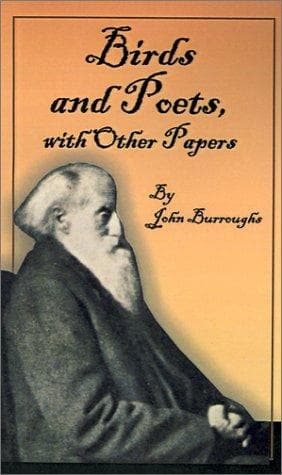
Birds and Poets : with Other PapersBurroughs, John
History
Birds and Poets : with Other Papers
Burroughs, John
American essays -- 19th century; Birds; Natural history -- Outdoor books; Nature
The physical cosmos itself is not a thought, but an act. Natural objects
do not affect us like well-wrought specimens or finished handicraft,
which have nothing to follow, but as living, procreating energy. Nature
is perpetual transition. Everything passes and presses on; there is no
pause, no completion, no explanation. To produce and multiply endlessly,
without ever reaching the last possibility of excellence, and without
committing herself to any end, is the law of Nature.
These considerations bring us very near the essential difference
between prose and poetry, or rather between the poetic and the didactic
treatment of a subject. The essence of creative art is always the same;
namely, interior movement and fusion; while the method of the didactic
or prosaic treatment is fixity, limitation. The latter must formulate
and define; but the principle of the former is to flow, to suffuse, to
mount, to escape. We can conceive of life only as something constantly
_becoming._ It plays forever on the verge. It is never _in loco,_ but
always _in transitu._ Arrest the wind, and it is no longer the wind;
close your hands upon the light, and behold, it is gone.
The antithesis of art in method is science, as Coleridge has intimated.
As the latter aims at the particular, so the former aims at the
universal. One would have truth of detail, the other truth of
_ensemble._ The method of science may be symbolized by the straight
line, that of art by the curve. The results of science, relatively to
its aim, must be parts and pieces; while art must give the whole
in every act; not quantitively of course, but qualitively,--by the
integrity of the spirit in which it works.
The Greek mind will always be the type of the artist mind, mainly
because of its practical bent, its healthful objectivity. The Greek
never looked inward, but outward. Criticism and speculation were foreign
to him. His head shows a very marked predominance of the motive and
perceptive powers over the reflective. The expression of the face is
never what we call intellectual or thoughtful, but commanding. His gods
are not philosophers, but delight in deeds, justice, rulership.
Public-domain text, read in full here on John Shaqi.
Reviews
Reviews
No reviews yet
Be the first to share your thoughts on this work.
Elsewhere in the archive
Join the Discussion
Join the discussion
Sign in to leave a comment or review.
Sign InorCreate an account