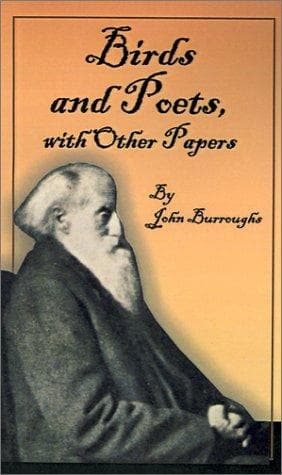
Birds and Poets : with Other PapersBurroughs, John
History
Birds and Poets : with Other Papers
Burroughs, John
American essays -- 19th century; Birds; Natural history -- Outdoor books; Nature
"Keen as are the arrows
Of that silver sphere,
Whose intense lamp narrows
In the white dawn clear,
Until we hardly see--we feel that it is there;
"All the earth and air
With thy voice is loud,
As, when Night is bare,
From one lonely cloud
The moon rains out her beams, and Heaven is overflowed."
Wordsworth has written two poems upon the lark, in one of which he calls
the bird "pilgrim of the sky." This is the one quoted by Emerson in
"Parnassus." Here is the concluding stanza:--
"Leave to the nightingale her shady wood;
A privacy of glorious light is thine,
Whence thou dost pour upon the world a flood
Of harmony, with instinct more divine;
Type of the wise, who soar, but never roam,
True to the kindred points of heaven and home."
The other poem I give entire:--
"Up with me! up with me into the clouds!
For thy song, Lark, is strong;
Up with me, up with me into the clouds!
Singing, singing,
With clouds and sky about thee ringing,
Lift me, guide me till I find
That spot which seems so to thy mind!
"I have walked through wilderness dreary,
And to-day my heart is weary;
Had I now the wings of a Faery
Up to thee would I fly.
There is madness about thee, and joy divine
In that song of thine;
Lift me, guide me high and high
To thy banqueting-place in the sky.
"Joyous as morning
Thou art laughing and scorning;
Thou hast a nest for thy love and thy rest,
And, though little troubled with sloth,
Drunken Lark! thou wouldst be loth
To be such a traveler as I.
Happy, happy Liver!
With a soul as strong as a mountain river,
Pouring out praise to the Almighty Giver,
Joy and jollity be with us both!
"Alas! my journey, rugged and uneven,
Through prickly moors or dusty ways must wind;
But hearing thee, or others of thy kind,
As full of gladness and as free of heaven,
I, with my fate contented, will plod on,
And hope for higher raptures, when life's day is done."
But better than either--better and more than a hundred pages--is
Shakespeare's simple line,--
"Hark, hark, the lark at heaven's gate sings,"
or John Lyly's, his contemporary,--
"Who is't now we hear?
None but the lark so shrill and clear;
Now at heaven's gate she claps her wings,
The morn not waking till she sings."
Public-domain text, read in full here on John Shaqi.
Reviews
Reviews
No reviews yet
Be the first to share your thoughts on this work.
Join the Discussion
Join the discussion
Sign in to leave a comment or review.
Sign InorCreate an account