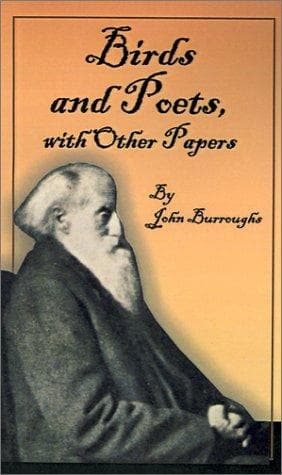
Birds and Poets : with Other PapersBurroughs, John
History
Birds and Poets : with Other Papers
Burroughs, John
American essays -- 19th century; Birds; Natural history -- Outdoor books; Nature
When Tyndall was here, he showed us how the dark, coarse, invisible heat
rays could be strained out of the spectrum; or, in other words, that
every solar beam was weighted with a vast, nether, invisible side, which
made it a lever of tremendous power in organic nature. After some such
analogy, one sees how the highest order of power in the intellectual
world draws upon and is nourished by those rude, primitive, barbaric
human qualities that our culture and pietism tend to cut off and strain
out. Our culture has its eye on the other end of the spectrum, where
the fine violet and indigo rays are; but all the lifting, rounding,
fructifying powers of the system are in the coarse, dark rays--the
black devil--at the base. The angel of light is yoked with the demon of
darkness, and the pair create and sustain the world.
In rare souls like Emerson, the fruit of extreme culture, it is
inevitable that at least some of the heat rays should be lost, and we
miss them especially when we contrast him with the elder masters. The
elder masters did not seem to get rid of the coarse or vulgar in human
life, but royally accepted it, and struck their roots into it, and drew
from it sustenance and power: but there is an ever-present suspicion
that Emerson prefers the saints to the sinners; prefers the prophets and
seers to Homer, Shakespeare, and Dante. Indeed, it is to be distinctly
stated and emphasized, that Emerson is essentially a priest, and that
the key to all he has said and written is to be found in the fact
that his point of view is not that of the acceptor, the
creator,--Shakespeare's point of view,--but that of the refiner and
selector, the priest's point of view. He described his own state rather
than that of mankind when he said, "The human mind stands ever in
perplexity, demanding intellect, demanding sanctity, impatient equally
of each without the other."
Much surprise has been expressed in literary circles in this country
that Emerson has not followed up his first off-hand indorsement of Walt
Whitman with fuller and more deliberate approval of that poet, but has
rather taken the opposite tack. But the wonder is that he should have
been carried off his feet at all in the manner he was; and it must
have been no ordinary breeze that did it. Emerson shares with his
contemporaries the vast preponderance of the critical and discerning
intellect over the fervid, manly qualities and faith. His power of
statement is enormous; his scope of being is not enormous. The prayer
he uttered many years ago for a poet of the modern, one who could see in
the gigantic materialism of the times the carnival of the same deities
we so much admire in Greece and Rome, seems to many to have even been
explicitly answered in Whitman; but Emerson is balked by the cloud of
materials, the din and dust of action, and the moving armies, in which
the god comes enveloped.
Public-domain text, read in full here on John Shaqi.
Reviews
Reviews
No reviews yet
Be the first to share your thoughts on this work.
Elsewhere in the archive
Join the Discussion
Join the discussion
Sign in to leave a comment or review.
Sign InorCreate an account