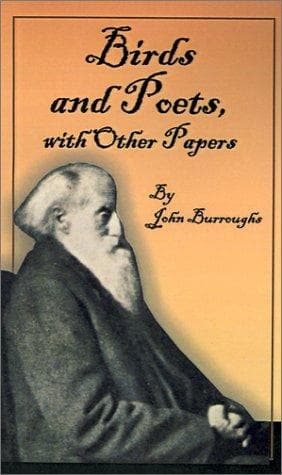
Birds and Poets : with Other PapersBurroughs, John
History
Birds and Poets : with Other Papers
Burroughs, John
American essays -- 19th century; Birds; Natural history -- Outdoor books; Nature
But Emerson has his difficulties with all the poets. Homer is too
literal, Milton too literary, and there is too much of the whooping
savage in Whitman. He seems to think the real poet is yet to appear; a
poet on new terms, the reconciler, the poet-priest,--one who shall unite
the whiteness and purity of the saint with the power and unction of the
sinner; one who shall bridge the chasm between Shakespeare and St. John.
For when our Emerson gets on his highest horse, which he does only on
two or three occasions, he finds Shakespeare only a half man, and
that it would take Plato and Manu and Moses and Jesus to complete him.
Shakespeare, he says, rested with the symbol, with the festal beauty of
the world, and did not take the final step, and explore the essence
of things, and ask, "Whence? What? and Whither?" He was not wise for
himself; he did not lead a beautiful, saintly life, but ate, and drank,
and reveled, and affiliated with all manner of persons, and quaffed the
cup of life with gusto and relish. The elect, spotless souls will always
look upon the heat and unconscious optimism of the great poet with deep
regret. But if man would not become emasculated, if human life is to
continue, we must cherish the coarse as well as the fine, the root as
well as the top and flower. The poet-priest in the Emersonian sense
has never yet appeared, and what reason have we to expect him? The poet
means life, the whole of life,--all your ethics and philosophies, and
essences and reason of things, in vital play and fusion, clothed with
form and color, and throbbing with passion: the priest means a part, a
thought, a precept; he means suppression, expurgation, death. To have
gone farther than Shakespeare would have been to cease to be a poet, and
to become a mystic or a seer.
Yet it would be absurd to say, as a leading British literary journal
recently did, that Emerson is not a poet. He is one kind of a poet. He
has written plenty of poems that are as melodious as the hum of a wild
bee in the air,--chords of wild aeolian music.
Undoubtedly his is, on the whole, a bloodless kind of poetry. It
suggests the pale gray matter of the cerebrum rather than flesh and
blood. Mr. William Rossetti has made a suggestive remark about him. He
is not so essentially a poet, says this critic, as he is a Druid that
wanders among the bards, and strikes the harp with even more than bardic
stress.
Not in the poetry of any of his contemporaries is there such a burden
of the mystery of things, nor are there such round wind-harp tones, nor
lines so tense and resonant, and blown upon by a breeze from the highest
heaven of thought. In certain respects he has gone beyond any other. He
has gone beyond the symbol to the thing signified. He has emptied poetic
forms of their meaning and made poetry of that. He would fain cut the
world up into stars to shine in the intellectual firmament. He is more
and he is less than the best.
Public-domain text, read in full here on John Shaqi.
Reviews
Reviews
No reviews yet
Be the first to share your thoughts on this work.
Elsewhere in the archive
Join the Discussion
Join the discussion
Sign in to leave a comment or review.
Sign InorCreate an account