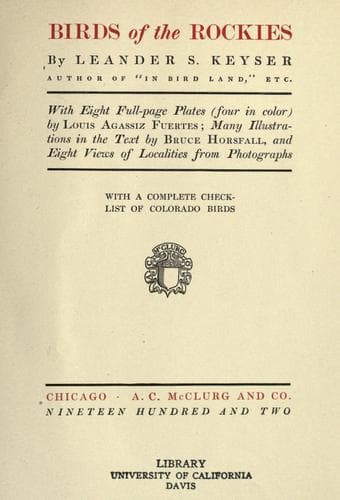
Birds of the RockiesKeyser, Leander S. (Leander Sylvester)
History
Birds of the Rockies
Keyser, Leander S. (Leander Sylvester)
Birds; Birds -- Colorado
In the vicinity of Manitou many trips were taken by the zealous
pedestrian. Some of the dry, steep sides of the first range of mountains
were hard climbing, but it was necessary to make the effort in order to
discover their avian resources. One of the first birds met with on these
unpromising acclivities was the spurred towhee of the Rockies. In his
attire he closely resembles the towhee, or "chewink," of the East, but
has as an extra ornament a beautiful sprinkling of white on his back and
wings, which makes him look as if he had thrown a gauzy mantle of silver
over his shoulders.
But his song is different from our eastern towhee's. My notes say that
it is "a cross between the song of the chewink and that of dickcissel,"
and I shall stand by that assertion until I find good reason to disown
it--should that time ever come. The opening syllabication is like
dickcissel's; then follows a trill of no specially definable character.
There are times when he sings with more than his wonted force, and it is
then that his tune bears the strongest likeness to the eastern towhee's.
But his alarm-call! It is no "chewink" at all, but almost as close a
reproduction of a cat's mew as is the catbird's well-known call. Such
crosses and anomalies does this country produce!
On the arid mountain sides among the stunted bushes, cactus plants,
sand, and rocks, this quaint bird makes his home, coming down into the
valleys to drink at the tinkling brooks and trill his roundelays. Many,
many times, as I was following a deep fissure in the mountains, his
ditty came dripping down to me from some spot far up the steep mountain
side--a little cascade of song mingling with the cascades of the brooks.
The nests are usually placed under a bush on the sides of the mesas and
mountains.
And would you believe it? Colorado furnishes another towhee, though why
he should have been put into the Pipilo group by the ornithologists is
more than I can tell at this moment. He has no analogue in the East.
True, he is a bird of the bushes, running sometimes like a little deer
from one clump to another; but if you should see him mount a boulder or
a bush, and hear him sing his rich, theme-like, finely modulated song,
you would aver that he is closer kin to the thrushes or thrashers than
to the towhees. There is not the remotest suggestion of the towhee
minstrelsy in his prolonged and well-articulated melody. It would be
difficult to find a finer lyrist among the mountains.
Public-domain text, read in full here on John Shaqi.
Reviews
Reviews
No reviews yet
Be the first to share your thoughts on this work.
Join the Discussion
Join the discussion
Sign in to leave a comment or review.
Sign InorCreate an account