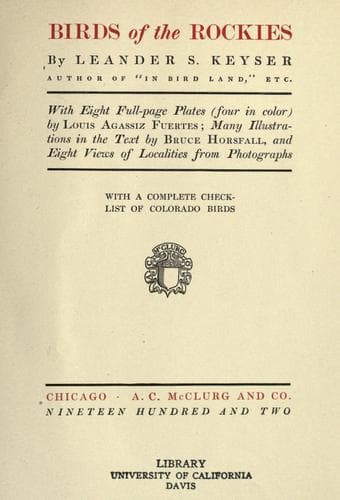
Birds of the RockiesKeyser, Leander S. (Leander Sylvester)
History
Birds of the Rockies
Keyser, Leander S. (Leander Sylvester)
Birds; Birds -- Colorado
But, hold! I have neglected to introduce this pretty Mozart of the West.
He is known by an offensive and inapt title--the green-tailed towhee.
Much more appropriately might he be called the chestnut-crowned towhee,
for his cope is rich chestnut, and the crest is often held erect, making
him look quite cavalier-like. It is the most conspicuous part of his
toilet. His upper parts are grayish-green, becoming slightly deeper
green on the tail, from which fact he derives his common name. His white
throat and chin are a further diagnostic mark. The bright yellow of the
edge of the wings, under coverts and axillaries is seldom seen, on
account of the extreme wariness of the bird.
In most of the dry and bushy places I found him at my elbow--or, rather,
some distance away, but in evidence by his mellifluous song. Let me
enumerate the localities in which I found my little favorite: Forty
miles out on the plain among some bushes of a shallow dip; among the
foothills about Colorado Springs and Manitou; on many of the open bushy
slopes along the cog-road leading to Pike's Peak, but never in the dark
ravines or thick timber; among the bushes just below timber-line on the
southern acclivity of the peak; everywhere around the village of Buena
Vista; about four miles below Leadville; and, lastly, beyond the range
at Red Cliff and Glenwood.[1]
[1] This list was greatly enlarged in my second trip to Colorado in
1901.
The song, besides its melodious quality, is full of expression. In this
respect it excels the liquid chansons of the mountain hermit thrush,
which is justly celebrated as a minstrel, but which does not rehearse a
well-defined theme. The towhee's song is sprightly and cheerful, wild
and free, has the swing of all outdoors, and is not pitched to a minor
key. It gives you the impression that a bird which sings so blithesome a
strain must surely be happy in his domestic relations.
Among the Rockies the black-headed grosbeak is much in evidence, and so
is his cheerful, good-tempered song, which is an exact counterpart of
the song of the rose-breasted grosbeak, his eastern kinsman. Neither the
rose-breast nor the cardinal is to be found in Colorado, but they are
replaced by the black-headed and blue grosbeaks, the former dwelling
among the lower mountains, the latter occurring along the streams of the
plains. Master black-head and his mate are partial to the scrub oaks for
nesting sites. I found one nest with four callow bantlings in it, but,
much to my grief and anger, at my next call it had been robbed of its
precious treasures. A few days later, not far from the same place, a
female was building a nest, and I am disposed to believe that she was
the mother whose children had been kidnapped.
Public-domain text, read in full here on John Shaqi.
Reviews
Reviews
No reviews yet
Be the first to share your thoughts on this work.
Join the Discussion
Join the discussion
Sign in to leave a comment or review.
Sign InorCreate an account