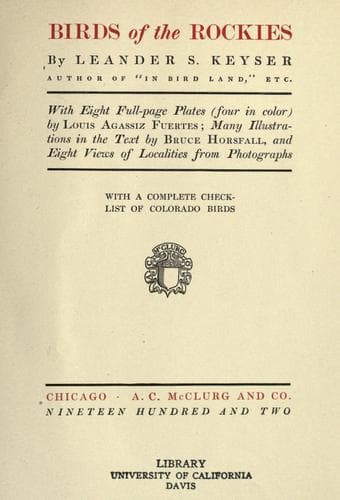
Birds of the RockiesKeyser, Leander S. (Leander Sylvester)
History
Birds of the Rockies
Keyser, Leander S. (Leander Sylvester)
Birds; Birds -- Colorado
Instead of the scarlet and summer tanagers, the Rocky Mountain region is
honored with that beautiful feathered gentleman, the Louisiana tanager,
most of whose plumage is rich, glossy yellow, relieved by black on the
wings, back, and tail; while his most conspicuous decoration is the
scarlet or crimson tinting of his head and throat, shading off into the
yellow of the breast. These colors form a picturesque combination,
especially if set against a background of green. The crimson staining
gives him the appearance of having washed his face in some bright-red
pigment, and like an awkward child, blotched his bosom with it in the
absence of a napkin.
So far as I could analyze it, there is no appreciable difference between
his lyrical performances and those of the scarlet tanager, both being a
kind of lazy, drawling song, that is slightly better than no bird music
at all. One nest was found without difficulty. It was placed on one of
the lower branches of a pine tree by the roadside at the entrance to
Engleman's Cañon. As a rule, the males are not excessively shy, as so
many of the Rocky Mountain birds are. The tanagers were seen far up in
the mountains, as well as among the foothills, and also at Red Cliff and
Glenwood on the western side of the Divide.
A unique character in feathers, one that is peculiar to the West, is the
magpie, who would attract notice wherever he should deign to live, being
a sort of grand sachem of the outdoor aviary. In some respects the
magpies are striking birds. In flight they present a peculiar
appearance; in fact, they closely resemble boys' kites with their long,
slender tails trailing in the breeze. I could not avoid the impression
that their tails were superfluous appendages, but no doubt they serve
the birds a useful purpose as rudders and balancing-poles. The magpie
presents a handsome picture as he swings through the air, the iridescent
black gleaming in the sun, beautifully set off with snowy-white
trimmings on both the upper and lower surfaces of the wings. On the
perch or on the wing he is an ornament to any landscape. As to his
voice--well, he is a genuine squawker. There is not, so far as I have
observed, a musical cord in his larynx,[2] and I am sure he does not
profess to be a musical genius, so that my criticism will do him no
injury. All the use he has for his voice seems to be to call his fellows
to a new-found banquet, or give warning of the approach of an interloper
upon his chosen preserves. His cry, if you climb up to his nest, is
quite pitiful, proving that he has real love for his offspring. Perhaps
the magpies have won their chief distinction as architects. Their nests
are really remarkable structures, sometimes as large as fair-sized
tubs, the framework composed of good-sized sticks, skilfully plaited
together, and the cup lined with grass and other soft material, making a
cosey nursery for the infantile magpies. Then the nest proper is roofed
Public-domain text, read in full here on John Shaqi.
Reviews
Reviews
No reviews yet
Be the first to share your thoughts on this work.
Join the Discussion
Join the discussion
Sign in to leave a comment or review.
Sign InorCreate an account