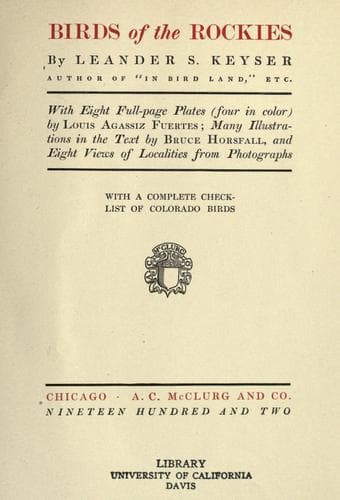
Birds of the RockiesKeyser, Leander S. (Leander Sylvester)
History
Birds of the Rockies
Keyser, Leander S. (Leander Sylvester)
Birds; Birds -- Colorado
Perhaps the reader will care to know something about the winter habits
of these birds. They do not spend the season of cold and storm in the
mountains, not even those that breed there, for the snow is very deep
and the tempests especially fierce. Many of them, however, remain in the
foothills and on the mesas and plains, where they find plenty of seeds
and berries for their sustenance, unless the weather chances to be
unusually severe. One winter, not long ago, the snow continued to lie
much longer than usual, cutting off the natural food supply of the
larks. What regimen did they adopt in that exigency? They simply went to
town. Many of the kindly disposed citizens of Colorado Springs scattered
crumbs and millet seeds on the streets and lawns, and of this supply the
little visitors ate greedily, becoming quite tame. As soon, however, as
the snow disappeared they took their departure, not even stopping to say
thanks or adieu; although we may take it for granted that they felt
grateful for favors bestowed.
Besides the horned larks, many other birds were found on the plain. Next
in abundance were the western meadow-larks. Persons who live in the
East and are familiar with the songs of the common meadow-lark, should
hear the vocal performances of the westerners. The first time I heard
one of them, the minstrelsy was so strange to my ear, so different from
anything I had ever heard, I was thrown into an ecstasy of delight, and
could not imagine from what kind of bird larynx so quaint a medley could
emanate. The song opened with a loud, fine, piercing whistle, and ended
with an abrupt staccato gurgle much lower in the musical staff, sounding
precisely as if the soloist's performance had been suddenly choked off
by the rising of water in the windpipe. It was something after the order
of the purple martin's melodious sputter, only the tones were richer and
fuller and the music better defined, as became a genuine oscine. His
sudden and emphatic cessation seemed to indicate that he was in a
petulant mood, perhaps impatient with the intruder, or angry with a
rival songster.
Afterwards I heard him--or, rather, one of his brothers--sing arias so
surpassingly sweet that I voted him the master minstrel of the western
plains, prairies, and meadows. One evening as I was returning to
Colorado Springs from a long tramp through one of the cañons of the
mountains, a western meadow-lark sat on a small tree and sang six
different tunes within the space of a few minutes. Two of them were so
exquisite and unique that I involuntarily sprang to my feet with a cry
of delight. There he sat in the lengthening shadows of Cheyenne
Mountain, the champion phrase-fluter of the irrigated meadow in which he
and a number of his comrades had found a summer home.
Public-domain text, read in full here on John Shaqi.
Reviews
Reviews
No reviews yet
Be the first to share your thoughts on this work.
Join the Discussion
Join the discussion
Sign in to leave a comment or review.
Sign InorCreate an account