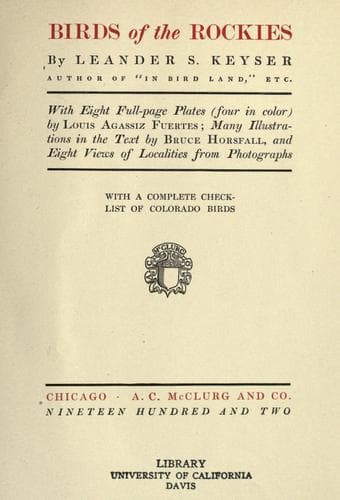
Birds of the RockiesKeyser, Leander S. (Leander Sylvester)
History
Birds of the Rockies
Keyser, Leander S. (Leander Sylvester)
Birds; Birds -- Colorado
On the plain, at the time of my visit, the meadow-larks were not quite
so tuneful, for here the seasons are somewhat earlier than in the
proximity of the mountains, and the time of courtship and incubation was
over. Still, they sang enough to prove themselves members of a gifted
musical family. Observers in the East will remember the sputtering call
of the eastern larks when they are alarmed or their suspicions are
aroused. The western larks do not utter alarums of that kind, but a
harsh "chack" instead, very similar to the call of the grackles. The
nesting habits of the eastern and western species are the same, their
domiciles being placed on the ground amid the grass, often prettily
arched over in the rear and made snug and neat.
It must not be thought, because my monograph on the western larks is
included in this chapter, that they dwell exclusively on the arid plain.
No; they revel likewise in the areas of verdure bordering the streams,
in the irrigated fields and meadows, and in the watered portions of the
upper mountain parks.
An interesting question is the following: Are the eastern and western
meadow-larks distinct species, or only varieties somewhat specialized by
differences of locality and environment? It is a problem over which the
scientific professors have had not a little disputation. My own opinion
is that they are distinct species and do not cohabit, and the conviction
is based on some special investigations, though not of the kind that are
made with the birds in hand. It has been my privilege to study both
forms in the field. In the first place, their vocal exhibitions are very
different, so much so as to indicate a marked diversity in the organic
structure of their larynxes. Much as I have listened to their
minstrelsy, I have never known one kind to borrow from the musical
repertory of the other. True, there are strains in the arias of the
westerners that closely resemble the clear, liquid whistle of the
eastern larks, but they occur right in the midst of the song and are
part and parcel of it, and therefore afford no evidence of mimicry or
amalgamation. Even the trills of the grassfinch and the song-sparrow
have points of similarity; does that prove that they borrow from each
other, or that espousals sometimes occur between the two species?
Public-domain text, read in full here on John Shaqi.
Reviews
Reviews
No reviews yet
Be the first to share your thoughts on this work.
Join the Discussion
Join the discussion
Sign in to leave a comment or review.
Sign InorCreate an account