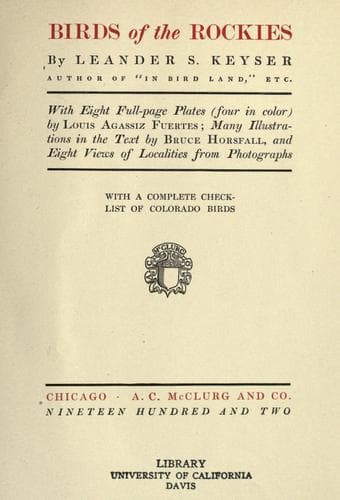
Birds of the RockiesKeyser, Leander S. (Leander Sylvester)
History
Birds of the Rockies
Keyser, Leander S. (Leander Sylvester)
Birds; Birds -- Colorado
[4] He sometimes ventures, though sparingly, as far east as Illinois
and Wisconsin; still my statement is true--I have never heard the
western lark even in the bottoms and meadows of the broad valley
east of the Missouri River, while, one spring morning, I did hear
one of these birds fluting in the top of a cottonwood tree in my
yard on the high western bluff of that stream.
After the foregoing deductions had been reached, the writer bethought
him of consulting Ridgway's Manual on the subject, and was gratified to
find his views corroborated by a footnote answering to an asterisk
affixed to the name of the western lark:
"Without much doubt a distinct species. The occurrence of both _S.
neglecta_ and _S. magna_ together in many portions of the
Mississippi Valley, each in its typical style (the ranges of the two
overlapping, in fact, for a distance of several hundred miles),
taken together with the excessive rarity of intermediate specimens
and the universally attested radical difference in their notes, are
facts wholly incompatible with the theory of their being merely
geographical races of the same species."
This has been a long _excursus_, and we must get back to our jaunt on
the plain. While I was engaged in watching the birds already named, my
ear was greeted by a loud, clear, bell-like call; and, on looking in the
direction from which it came, I observed a bird hovering over a ploughed
field not far away, and then descending with graceful, poising flight to
the ground. It proved to be the Arkansas flycatcher, a large, elegant
bird that is restricted to the West. I had never seen this species.
Nothing like him is known in the East, the crested flycatcher being most
nearly a copy of him, although the manners of the two birds are quite
unlike. The body of the western bird is as large as that of the robin,
and he must be considerably longer from tip of beak to tip of tail. He
is a fine-looking fellow, presenting a handsome picture as he stands on
a weed-stalk or a fence-post, his yellow jacket gleaming in the sun. He
is the possessor of a clear, musical voice, and if he had the vocal
organs of some of the oscines, he certainly would be one of the best
feathered lyrists of America. Unfortunately he is able to do nothing but
chirp and chatter, although he puts not a little music into his simple
vocal exercises.
It was surprising to note on how slender a weed-stalk so large a bird
was able to perch. There being few trees and fences in this region, he
has doubtless gained expertness through practice in the art of securing
a foot-hold on the tops of the weed-stems. Some of the weeds on which he
stood with perfect ease and grace were extremely lithe and flexible and
almost devoid of branches.
Public-domain text, read in full here on John Shaqi.
Reviews
Reviews
No reviews yet
Be the first to share your thoughts on this work.
Join the Discussion
Join the discussion
Sign in to leave a comment or review.
Sign InorCreate an account