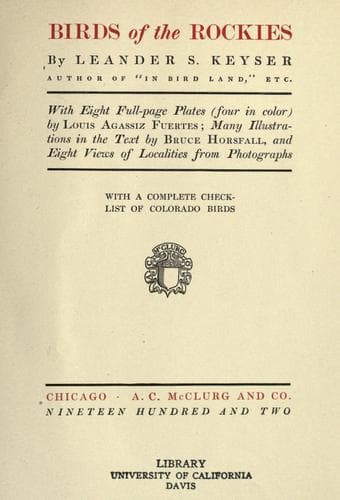
Birds of the RockiesKeyser, Leander S. (Leander Sylvester)
History
Birds of the Rockies
Keyser, Leander S. (Leander Sylvester)
Birds; Birds -- Colorado
The habiliments of the two forms of larks are more divergent than would
appear at first blush. Above, the coloration of _neglecta_ (the western)
is paler and grayer than that of _magna_, the black markings being less
conspicuous, and those on the tertials and middle tail-feathers being
arranged in narrow, isolated bars, and not connected along the shaft.
While the flanks and under tail-coverts of _magna_ are distinctly washed
with buff, those of _neglecta_ are white, very faintly tinged with buff,
if at all. The yellow of the throat of the eastern form does not spread
out laterally over the malar region, as does that of the western lark.
All of which tends to prove that the two forms are distinct.
Early in the spring of 1901 the writer took a trip to Oklahoma in the
interest of bird-study, and found both kinds of meadow-larks extremely
abundant and lavish of their melodies on the fertile prairies. He
decided to carry on a little original investigation in the field of
inquiry now under discussion. One day, in a draw of the prairie, he
noticed a western meadow-lark which was unusually lyrical, having the
skill of a past-master in the art of trilling and gurgling and fluting.
Again and again I went to the place, on the same day and on different
days, and invariably found the westerner there, perching on the fence or
a weed-stem, and greeting me with his exultant lays. But, mark: no
eastern lark ever intruded on his preserve. In other and more distant
parts of the broad field the easterners were blowing their piccolos, but
they did not encroach on the domain of the lyrical westerner, who, with
his mate--now on her nest in the grass--had evidently jumped his claim
and held it with a high hand. In many other places in Oklahoma and
Kansas where both species dwell, I have noticed the same interesting
fact--that in the breeding season each form selects a special precinct,
into which the other form does not intrude. They perhaps put up some
kind of trespass sign. These observations have all but convinced me that
_S. magna_ and _S. neglecta_ are distinct species, and avoid getting
mixed up in their family affairs.
Nor is that all. While both forms dwell on the vast prairies of
Oklahoma, Kansas, and Nebraska, yet, as you travel eastward, the western
larks gradually diminish in number until at length they entirely
disappear; whereas, if you journey westward, the precise opposite
occurs. I have never heard _neglecta_ east of the Missouri River,[4] nor
_magna_ on the plains of Colorado. Therefore the conclusion is almost
forced upon the observer that there are structural and organic
differences between the two forms.
Public-domain text, read in full here on John Shaqi.
Reviews
Reviews
No reviews yet
Be the first to share your thoughts on this work.
Join the Discussion
Join the discussion
Sign in to leave a comment or review.
Sign InorCreate an account