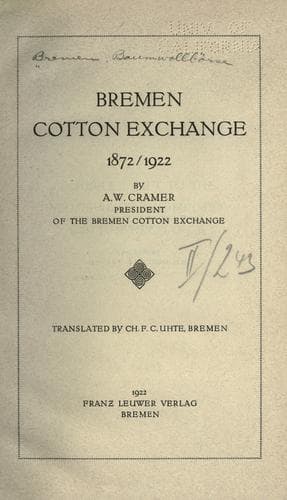
Bremen Cotton Exchange, 1872/1922Cramer, Andreas Wilhelm
History
Bremen Cotton Exchange, 1872/1922
Cramer, Andreas Wilhelm
Bremen (Germany). Baumwollbörse; Cotton trade
American cotton is divided into a number of classes, and each has its
standard. Originally, these standards were obtained from Liverpool, but
later on, Bremen produced the standards independently. There are
original standards and standard copies; the former, remain unchanged,
while the latter are renewed every year, because, through constant use,
they are liable to deteriorate. The freshly made up standards are
subject to the examination and approval of a Committee, elected for
that purpose, and which consists of Members of the Trade and the
Industry. The sworn classers are nominated by the directors, and
concern themselves solely with the classing and arbitrating of cotton.
They have sworn a solemn oath, to conduct their office with absolute
impartiality; this is further safeguarded by the fact, that the names
of the parties interested are kept strictly secret. If a party
consider, that they have a right to complain about the verdict of the
classers, they can appeal against the decision. The verdict of the
appeal is given by Appeal Judges, who are appointed by a Committee,
elected for that purpose. They are selected from the merchants and
spinners, and great care is exercised that they possess the necessary
expert knowledge. The names of the interested parties are also withheld
from the appeal judges, nor are they informed whether buyer or seller
have appealed. It is of great advantage to the whole arbitration
system, that the appeal judges are actively engaged in the cotton
business, by this means a bureaucratic verdict is avoided. Up to a
point, the arbitrators and appeal judges work together, and thereby,
the former remain in close touch with the general business life, which
is of importance for various reasons. It is not sufficient for a
correct verdict, to simply compare the cotton with the standards, the
judges must know, how the difference in the quality is to be valued;
and how far the character of each crop is to be taken into
consideration, etc. etc. It is therefore apparent, that the judging of
cotton requires a certain connection with the actual business activity,
and, it is certain, that only the commerce itself can produce and
educate the individuals, who are chosen to pronounce an expert opinion
upon questions of such importance and difficulty.
* * * * *
The "Bremen Cotton Exchange" does not only decide questions concerning
quality, but settles also all other disputes, which may arise between
members. These decisions are given by, what may be called, a court of
arbitration and a court of appeal. To the former each party appoints
its own expert, while the Exchange appoints the experts to the latter.
The conditions of the "Bremen Cotton Exchange" are adapted to the
common law, but take into account, the decided peculiarities of the
cotton trade.
Public-domain text, read in full here on John Shaqi.
Reviews
Reviews
No reviews yet
Be the first to share your thoughts on this work.
Join the Discussion
Join the discussion
Sign in to leave a comment or review.
Sign InorCreate an account