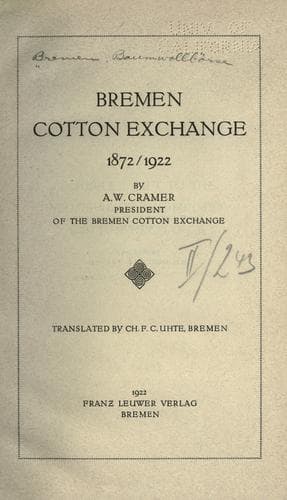
Bremen Cotton Exchange, 1872/1922Cramer, Andreas Wilhelm
History
Bremen Cotton Exchange, 1872/1922
Cramer, Andreas Wilhelm
Bremen (Germany). Baumwollbörse; Cotton trade
The following is an explanation of an important point, where the
conditions differ from the Common Law. A deviation from the guaranteed
quality, does not give the buyer the right to cancel the contract. He
is awarded an allowance, when the difference is small; if the
inferiority be greater, penalty is added to the allowance, but, when a
heavy allowance is not likely to compensate the buyer for the damage
sustained, he may return the cotton, but not by cancelling the
contract. In such cases, the contract will be what is called,
"regulated" or "invoiced back", in which method, the market differences
are duly taken into account, with the addition of penalty for the
guilty party. When sales are made for specified deliveries, and these
should not be made within the proper time, the buyer has also the right
of invoicing back, in the manner described. This invoicing back, takes
the place of the cancelling of a contract, according to law.
It is possible, that when a party practically goes by default on a
contract, through a very inferior tender, or by a late delivery, they
may yet be entitled to claim from the other party, a difference in
price. For instance: Somebody sells cotton at 22 cents, the market
drops to 20 cents, the contract is invoiced back for bad delivery,
then, the seller, who is the guilty party, has a claim against the
buyer, for a difference in the market of 2 cents less penalty of 2% =
0.44 cents, equalling 1.56 cents net.
This claim would not be possible according to Common Law. The
conditions of the "Bremen Cotton Exchange" make it a principal, that no
party shall take an advantage of the market fluctuations.
In the above case, the buyer would have a profit of 2 cents, if he
could have simply cancelled the contract on account of bad delivery,
because he could have immediately re-bought the cotton at 20 cents,
while all his calculations were based on a purchase at 22 cents. This
apparently strange fact, that the innocent should pay to the guilty, is
the direct consequence of the elimination of market fluctuations from
the Law Codes.
It has been of great benefit to all concerned, that any differences of
opinions are promptly settled by the "Bremen Cotton Exchange", and not
by having resort to a costly and wearisome law suit. Everybody in
cotton knows, that quarreling is always bad business, and, it is with
some pride, that the cotton Exchange looks back upon the big number of
decisions given.
Only very rarely has it happened, that disputes have been referred to
the ordinary Law Courts. The "Bremen Cotton Exchange" has, according to
the Rules, the power to do so, but that right is only exercised, where
purely matters of Law are concerned.
THE UNION WITH THE INDUSTRY.
Public-domain text, read in full here on John Shaqi.
Reviews
Reviews
No reviews yet
Be the first to share your thoughts on this work.
Join the Discussion
Join the discussion
Sign in to leave a comment or review.
Sign InorCreate an account