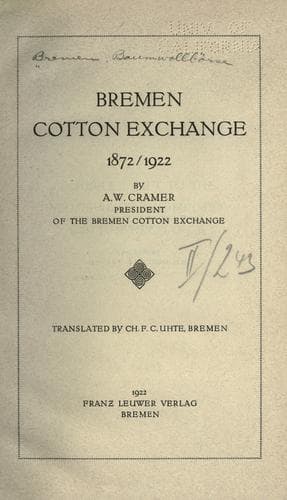
Bremen Cotton Exchange, 1872/1922Cramer, Andreas Wilhelm
History
Bremen Cotton Exchange, 1872/1922
Cramer, Andreas Wilhelm
Bremen (Germany). Baumwollbörse; Cotton trade
When 50 years ago, Germany awakened from its long impotence, her
citizens were received, without prejudice, all over the world, and no
obstacles were placed in the way of their diligence. This fact, we wish
gladly and thankfully to record. Many Germans were successful in
gaining a firm footing in the English Colonies, as well as in America,
and to attain there important positions. They formed a link between
their home country and the centres of trade and finance. Valuable
services were rendered by them to the German trade, but London remained
the Banker of the world, and when an industry began to grow in Germany,
it was, in many cases, the English, who furnished the first capital.
When the cotton market started to develop in Bremen, most of the
financing was done by English bankers, anyhow at first. Later on,
German Banks participated, and it is greatly to their credit, that they
showed such great interest and understanding for the requirements of
that trade. In the year 1871, the first German Bank of importance
opened its doors in Bremen, and others followed, as the trade expanded.
The cotton trade remained, in a certain measure, true to the English
banks, while the other branches of commerce worked mostly through
German banks, and a great incentive was given to this, by the fact,
that American bankers considered German money equal to the American and
English values.
How do we pay for the cotton, which we import?
The planter receives the purchase price from the shipper, through any
one of the numerous banks in the South. Of course, we cannot give the
actual dollars to the shipper, consequently, he or his banker has to
advance them for a short period. Before the war, we opened a credit
with English or German banks, in favor of the shipper, a so-called
reimbursement credit, by which he could recover his advanced purchase
price. When opening this credit, we took care, however, to have proof
that the goods, for which we intended to pay, were certain to reach us
eventually. We made the condition, that, against the reimbursement
credit, the shipping documents were to be delivered. Against delivery
of these documents, the shipper drew a draft upon our bankers,
discounted the same, and the matter was settled. Now the bank was in
possession of the documents, and by accepting the draft, had guaranteed
to pay the purchase price. The position between the bank and ourselves,
was cleared in various ways, which depended upon private arrangements.
We, as cotton importers, had to receive the purchase price from the
consumer in the interior, before we could satisfy our bank. As the sale
of the goods could not always be effected promptly, we remained debtors
to the bankers for the purchase price, while they were in possession of
the goods or the documents. The settlement of transactions of this
kind, requires a certain amount of trust and confidence, which the
bankers have to grant to the merchants, on the other hand, they have
Public-domain text, read in full here on John Shaqi.
Reviews
Reviews
No reviews yet
Be the first to share your thoughts on this work.
Join the Discussion
Join the discussion
Sign in to leave a comment or review.
Sign InorCreate an account