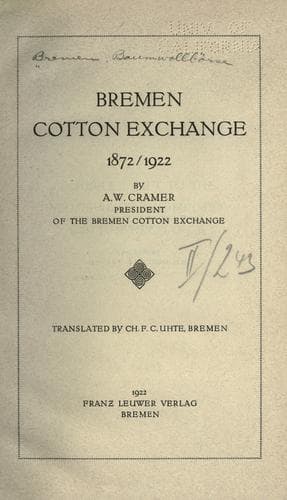
Bremen Cotton Exchange, 1872/1922Cramer, Andreas Wilhelm
History
Bremen Cotton Exchange, 1872/1922
Cramer, Andreas Wilhelm
Bremen (Germany). Baumwollbörse; Cotton trade
The "Insurance certificate" confirms, that the goods have been insured
on the terms of an insurance policy, which remains in America, and in
case of claims, it has the same documentary value as the policy itself.
When "total loss", "general average" or "particular average" occur,
claims on the insurer can be made, which must be substantiated in the
port of discharge.
Any claim, referring to difference in quality or loss in weight, has to
be made on receiving the goods, and the complaint has to be lodged
within a certain specified time. On these points, the Bremen Cotton
Exchange has specific rules which are easily understood.
If one party to a purchase or sale contract goes by default, the other
party is obliged to send in their claim within the time stipulated by
the rules of the Bremen Cotton Exchange, this is most important, as the
non-observance may mean the loss of any right to claim. The method in
which these claims are made up, is easily seen from the Rules of the
Bremen Cotton Exchange.
If one party suspends payment, all unfulfilled contracts are
immediately settled, without any action of the other party. The
obligation to take or make delivery ceases, and, instead of this, the
difference in price is fixed which exists between the date of contract,
and the time when payment was suspended. These differences in price are
put to account between the parties concerned. It can thus easily
happen, that the solvent concern has to pay a considerable amount to
the other party, through whose fault the contract was not carried out,
and yet, this constitutes no loss to the paying party, as they can at
once cover themselves at the existing prices. The advantage of this
procedure lies in the fact, that the solvent concern is not left in
uncertainty, whether their contracts will be fulfilled or not, while,
otherwise, this decision would rest with the liquidators, who,
according to Common Law, are not obliged to declare themselves, until
the stipulated time for delivery has been reached.
Of great importance in the cotton trade is the business for future
delivery, and that in a two-fold form. All transactions in "futures"
are governed by the stringent rules of the respective Exchanges, which
refer, particularly, to the price differences caused by the
fluctuations in the market, and the safeguarding of the interests thus
created.
Public-domain text, read in full here on John Shaqi.
Reviews
Reviews
No reviews yet
Be the first to share your thoughts on this work.
Join the Discussion
Join the discussion
Sign in to leave a comment or review.
Sign InorCreate an account