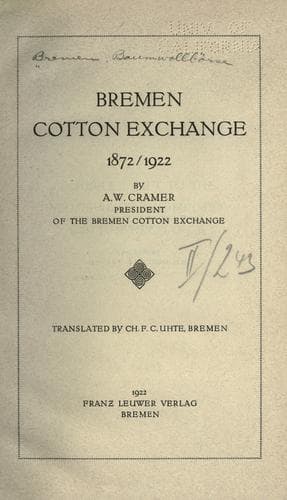
Bremen Cotton Exchange, 1872/1922Cramer, Andreas Wilhelm
History
Bremen Cotton Exchange, 1872/1922
Cramer, Andreas Wilhelm
Bremen (Germany). Baumwollbörse; Cotton trade
What are the forces which put life into the "future" market? The
world's trade is large, and every minute will find people, who, in the
pursuance of legitimate interests, buy or sell. When both groups are
fairly equal, the market is steady, while a decline or an advance is
caused by a preponderance of one over the other; finally, this adjusts
itself again, by the fact, that a rapid advance will produce sellers
and vice versa. A further element in the market, is the "jobber", whose
main object is to take advantage of the small fluctuation caused by
chance, but we must not forget the big speculators. By these, we do not
mean those despicable people who aim to snatch a profit, and who, on
having to face a loss, plead the gaming act. Experience and force of
circumstances have, luckily, driven these parasites almost out of the
market. But we do mean those big operators, who having weighed
carefully "the pros and cons" of the situation, cause the great "bull"
or bear movements.
TECHNICALITIES.
For those who wish to obtain information concerning the cotton trade
from this pamphlet, certain subjects are here elaborated, which were,
so far, only indicated in connection with other explanations.
Of first importance are the shipping documents, which consist of bills
of lading and insurance certificates. There are three kinds of bills of
lading: Port Bills of Lading, Custody Bills of Lading, and Through
Bills of Lading. The first must be signed by the captain of the
steamer, who has undertaken to carry the goods, or by a duly authorized
shipping agent. They are, therefore, an absolute guarantee on the part
of the ship, to deliver the goods to the holder of the bill of lading.
Unfortunately, this obligation is frequently restricted by the
insertion of certain inconspicuous clauses. The "custody bills of
lading" are signed by a shipping agent, they acknowledge receipt of the
goods, and promise the forwarding in due course. In order to obtain
equal value with the "port bill of lading," they should, later on, be
supplemented by a so-called "master's receipt", which is an
acknowledgment by the captain, that he has actually accepted the goods
for forwarding, in accordance with the conditions of the custody bill
of lading. They are used when the goods have arrived at the port,
previous to the ship.
The "through or railway" bills of lading, oblige the railway companies
to forward the goods from a place in the interior of America, to their
destination. A master's receipt is not necessary, but desirable, as it
is an easy means of ascertaining by which steamer the goods are coming
forward. At one time, "through or railway bills of lading" were not a
properly valid document, as the railway companies were not in duty
bound to forward the goods. Now, however, a change in the American Law
binds the companies to this duty.
Public-domain text, read in full here on John Shaqi.
Reviews
Reviews
No reviews yet
Be the first to share your thoughts on this work.
Join the Discussion
Join the discussion
Sign in to leave a comment or review.
Sign InorCreate an account