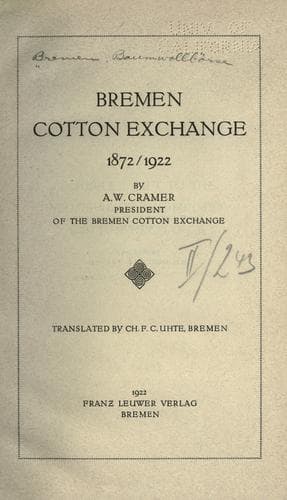
Bremen Cotton Exchange, 1872/1922Cramer, Andreas Wilhelm
History
Bremen Cotton Exchange, 1872/1922
Cramer, Andreas Wilhelm
Bremen (Germany). Baumwollbörse; Cotton trade
The Cotton Exchange does not trade, but under the war-conditions and in
the knowledge of being the centre of commerce and industry, a
courageous attempt was made. At the instigation of the Exchange,
commerce and the spinners of Germany and Austria-Hungaria united, to
give a bid for one million bales of cotton to the Americans. Cotton was
no contraband of war, and America was neutral, so no difficulties
seemed to be in the way of executing this plan. The buyer was prepared
to pay the price which the Americans might demand, and the goods were
to be paid in hard cash dollars. Yet the offer was not accepted,
although America had sufficient reason to seek an outlet for the big
crop it had grown, and that nobody wanted under the war conditions.
Politics were too mighty for the reasons of commerce!
After a while, all connections ceased with America. The Bremen Cotton
Exchange and the cotton trade were at a stand-still. Now and then, the
Exchange tried to place their establishment at the disposal of the
trade in substitutes, but only with moderate success. To build up a
lasting trade in substitutes was as impossible as it was to find a
market for the substitutes, when once cotton began to appear again.
THE RE-OPENING OF THE MARKET.
After the armistice, the possibility presented itself again, of
supplying the German cotton industry with raw material. The government,
however, made certain stipulations under which the import might be
carried on, but no hymn of praise can be sung about them.
Notwithstanding all difficulties, cotton found its way into the
country, and when, finally, all government measures were cancelled, the
legitimate business was restarted. All round the Bremen market,
competition had grown. Rotterdam made great exertions to push Bremen
aside, even Copenhagen made similar endeavours. A few American firms,
which were hostile to Germany, did their best to circumvent Bremen.
These efforts, however, were not crowned with success, Bremen regained
its position. It has been shown that the natural development through
many years, cannot be killed and artificially replaced. The manifold
relations, started in peace-time, of personal or business character,
showed their value. The economic life flows through a great network of
channels, should these be artificially closed, they will re-open again
of their own accord, as soon as the barriers have been removed. During
the war, the German cotton industry either stood still, or worked only
with a small percentage of its machinery. The government had husbanded
the supply of cotton most carefully, so that, after an unexpectedly
long war, a little was still left over. The mills which were running,
displayed great assiduity in procuring and utilizing substitutes for
cotton. Paper, wood, cellulose, reed and nettle fibres, and other
materials were tried, some were manufactured quite extensively. During
the war they did good service, but in normal times, they cannot usurp
the place of cotton.
Public-domain text, read in full here on John Shaqi.
Reviews
Reviews
No reviews yet
Be the first to share your thoughts on this work.
Join the Discussion
Join the discussion
Sign in to leave a comment or review.
Sign InorCreate an account