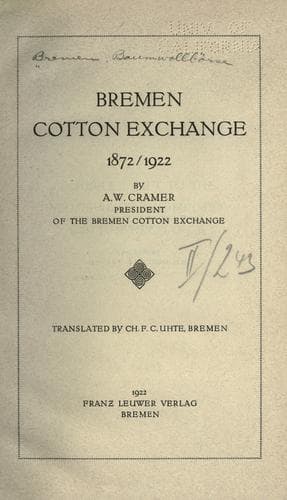
Bremen Cotton Exchange, 1872/1922Cramer, Andreas Wilhelm
History
Bremen Cotton Exchange, 1872/1922
Cramer, Andreas Wilhelm
Bremen (Germany). Baumwollbörse; Cotton trade
After surmounting many difficulties, the German
cotton industry is once more in full swing, and with it, Bremen is
again the important continental cotton market. The surrounding
countries buy in Bremen as of old, though some outlets are still
closed, owing to political and economic reasons.
During the last three years, before the war, the import of North
American cotton to Bremen averaged 2 500 000 bales, during the season
1920/21, it reached 1 200 000 bales, and in 1921/22, 1 500 000 bales,
the decline, against the former years, is caused, partly, by the
disappearance of some outlets, and partly, by the shorter working day.
AMERICAN CROPS AND CONSUMPTION.
The activity of the "Bremen Cotton Exchange" depends, to a large
extent, upon the import figures, and these again are under the
influence of the various crops. In America, big crops alternate with
small ones, the cause for this diversity is to be found in the climate
conditions, and also in the ruling range of price. High prices
stimulate an extensive planting and a careful cultivation of the
ground, while low prices have the contrary effect. The crop figures
from 1872-1914, were ascending, an occasional decline was made good
later on.
The following figures will make this clear.
American crops:
1872 3 650 000 bales
1875 4 302 000 "
1878 4 745 050 "
1881 5 136 000 "
1884 5 477 000 "
1887 6 884 000 "
1891 8 940 000 "
1894 10 025 000 "
1898 10 985 000 "
1901 9 749 000 "
1904 13 697 000 "
1907 11 326 000 "
1910 11 966 000 "
1913 14 614 000 "
1914 16 738 000 "
1915 12 013 000 "
1916 12 664 000 "
1917 12 345 000 "
1918 12 817 000 "
1919 11 921 000 "
1920 13 711 000 "
1921 8 000 000[1]"
[1] estimated.
The reverse, which the production suffered since 1914, is remarkable,
it is largely accounted for, by the want of artificial manure. German
potash could not be obtained, and this was largely used by all cotton
states, with the exception of Texas, Louisiana, Mississippi, Arkansas,
which do not require that kind of fertilizer. In addition, the boll
weevil has become a dreaded enemy of the cotton plant. The insect world
produces quite an army of little fiends, that viciously attack and
reduce the crop, many have disappeared, but the boll weevil is, at
present, the arch-enemy; it is a small beetle which bores into the
bolls to deposit its eggs there.
The following figures give the distribution of the American crops.
Public-domain text, read in full here on John Shaqi.
Reviews
Reviews
No reviews yet
Be the first to share your thoughts on this work.
Join the Discussion
Join the discussion
Sign in to leave a comment or review.
Sign InorCreate an account