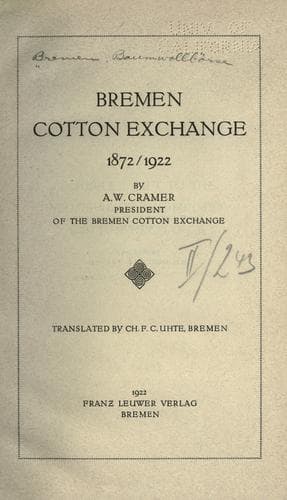
Bremen Cotton Exchange, 1872/1922Cramer, Andreas Wilhelm
History
Bremen Cotton Exchange, 1872/1922
Cramer, Andreas Wilhelm
Bremen (Germany). Baumwollbörse; Cotton trade
The chief country of production is the southern part of the United
States of North America. Considerable crops are also grown in East
India and Egypt, and lesser quantities come from the Caucasus,
Turkestan, China, Brazil, Argentine, Peru and Africa. The continental
consumption looks for the greater part to American cotton, but, also,
East Indian is extensively used. In the Southern States of America, the
first cotton ripens in August. The bolls containing cotton, will grow
well into the Autumn, and even in Winter new bolls will be formed, and
it is only a killing frost, which terminates the productive force of
the plant. When the bolls are ripe, they open, and then the picking
commences. As a rule, the first pickings are the best as to color and
cleanness, and the longer the bolls are exposed to the inclemencies of
the weather in Autumn and Winter, the more the quality will
deteriorate. The picked cotton consists of two thirds of seed and one
third of actual cotton. In order to obtain the fibre, the cotton is
passed through a ginning machine. From the seeds, edible oil is gained
and the residue is manufactured into food for cattle, while the cotton
is formed into bales in specially constructed presses. It is natural,
that cotton should show a great diversity of quality, owing to the
influence of weather during the long period of picking. The color of
cotton covers a fair range, one sees not only snow white and creamy
cotton, but also bluish, grey, red and mixed colors.
The value of cotton is determined by its quality and character. Of
chief importance is the percentage of the loss during the cleaning
process in the cotton mill. A normal percentage of loss for medium
grades is 10%, this is likely to be higher, if the cotton has been
picked during moist weather and contains much unripe cotton. The color
is also of great importance, discolored cotton has a decidedly lower
value, especially when this cannot be rectified by bleaching which is
mainly the case with heavily spotted or bluish cotton. An even greater
factor, than the outward appearance, is the inner value, which is
represented by the length and strength of the fibre (staple). The
staple length of common American cotton is from 24-28 mm. In great
request are the qualities, which have a longer staple than 28 mm,
especially when the staple is even, silky and strong. A difference of
only 1/2 mm in the length of the staple, may mean a difference of 10%
in the value. It is of the greatest importance to the cotton merchant
as well as to the spinner, that the cotton is correctly judged as
regards its outward appearance and the length of staple, this
adjudication or classing is by no means an easy task. A certain system
has been adopted by which the outward appearance of the cotton is fixed
by so-called standards into classes. A certain number of cotton samples
are arranged in a suitable flat box, in such a way that their surface
represents the color and cleanness of the respective class.
Public-domain text, read in full here on John Shaqi.
Reviews
Reviews
No reviews yet
Be the first to share your thoughts on this work.
Join the Discussion
Join the discussion
Sign in to leave a comment or review.
Sign InorCreate an account