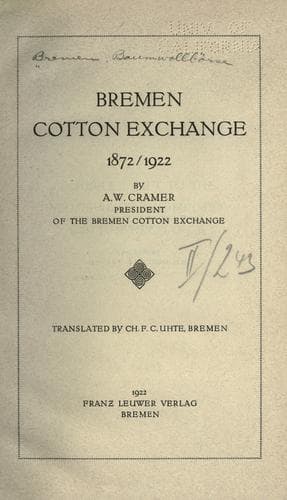
Bremen Cotton Exchange, 1872/1922Cramer, Andreas Wilhelm
History
Bremen Cotton Exchange, 1872/1922
Cramer, Andreas Wilhelm
Bremen (Germany). Baumwollbörse; Cotton trade
If a lot of
cotton is to be classed, samples are drawn from every bale, these are
placed together, sample by sample, and the total thus gained, is
compared with the standard. In this way an opinion is formed, whether
the cotton is equal to the class represented by the standard, or
whether it is below it, in which case, this difference in class has to
be valued. The judging of the staple is a very difficult task, 1/2 mm
is of importance, and yet it is impossible to measure staple correctly.
Anybody, even with the greatest dexterity in his fingers, will not be
able to draw from a piece of cotton the single fibres, place them in
such a way next to each other, that they appear like Swedish matches in
a box. A good expert, however, is able to draw the staple in a manner,
that the average length will be accurately judged. To give a correct
opinion on cotton, rooms with a good light are required, much
experience and good judgment.
Next in importance for continental consumption is Egyptian and East
Indian cotton. The former is divided into two kinds, the long stapled,
which grows on the lower Nile, the Delta, and the shorter stapled,
Upper Egyptian cotton. The long stapled Egyptian is utilised for the
very finest yarns, and its only rival is or was Sea-Island cotton. This
latter grows on a group of islands, not far from the shore of Georgia
which have a moist warm climate, but the boll-weevil has played serious
havoc with that crop, and the cultivation has been greatly curtailed.
East India produces shorter stapled descriptions of great variety, but
each has a character of its own, and yet to differentiate between them,
is a knotty problem, especially, as now and then, one comes across a
somewhat fraudulent mixture. The names are mostly derived from the
locality in which they grow, while the climate and condition of the
ground give the character, and in some cases, even distinctive smell,
for instance, Oomra cotton smells like musk; occasionally the smell is
an indisputable proof of origin.
It has taken the continental cotton industry a long time to grow from
small beginnings to its present importance. The never lacking
competition has brought about a great improvement in the quality and
variety of the articles produced. It is astounding to compare the raw
material in the fields, with the finished articles in the windows of
some lady's outfitting shop. It requires many diligent hands and high
class technical guidance, to transfer Nature's present of raw cotton
into the manifold articles, which the people, nowadays, require and
desire.
Public-domain text, read in full here on John Shaqi.
Reviews
Reviews
No reviews yet
Be the first to share your thoughts on this work.
Join the Discussion
Join the discussion
Sign in to leave a comment or review.
Sign InorCreate an account