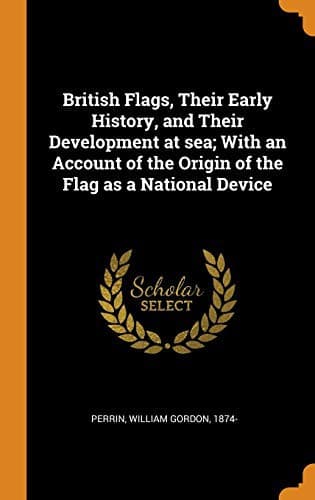
British Flags: Their Early History, and Their Development at Sea: With an Account of the Origin of the Flag as a National Device — John Shaqi
British Flags: Their Early History, and Their Development at Sea: With an Account of the Origin of the Flag as a National DevicePerrin, William Gordon
History
British Flags: Their Early History, and Their Development at Sea: With an Account of the Origin of the Flag as a National Device
Perrin, William Gordon
Flags -- Great Britain
[23] _Natural History_, Book X, 5 (4).
[24] Caesar, _B.G._ II, 20: vexillum proponendum, quod erat insigne,
quum ad arma concurri oporteret.
[25] Tacitus, _Hist._ V, 22: Namque praetoriam navem vexillo insignem,
illic ducem rati, abripiunt.
[26] _De Re Militari_, III, 5: "Muta signa sunt aquilae, dracones,
vexilla, flammulae, tufae, pinnae. Quocunque enim haec ferri iusserit
ductor, eo necesse est signum suum comitantes milites pergant." He is
here using the word _signum_ in the sense of signal, and divides these
signals into _vocalia_ or orders given by word of mouth, _semi-vocalia_
or those given by trumpet, and _muta_ or those denoted by the movement
of the standards.
[27] Du Cange, _Glossarium_: Tufa genus vexilli apud Romanos ex
confertis plumarum globis.
[28] See p. 30.
[29] _De Bello Civili_, II, 6: Conspirataeque naves triremes duae navem
D. Brut quae ex insigni facile agnosci poterant, duabus ex partibus
sese in eam incitaverant.
[30] Appian, V, 111: ἐπὶ δὲ τῇ παρακλήσει τὰ στρατηγικὰ σημεῖα, ὡς ἐν
κινδύνῳ μάλιστα ὤν, ἀπέθετο. [Greek: epi de tê paraklêsei ta stratêgika
sêmeia, hôs en kindynô malista ôn, apetheto.]
[31] Dio, LI, 21: σημείῳ κυανοειδεῖ ναυκρατητικῷ [Greek: sêmeiô
kyanoeidei naukratêtikô]. Suetonius II: caeruleo vexillo donavit.
[32] _Civil Wars_, V, 55.
[33] Alemannus, _De Lateranensibus parietinis_.
[34] _De Rebus Hispaniae_, III, 18: Arabum ... qui sua capita tegunt
vittis, ... habentes vestis diversis coloribus variegatas, tenentes
gladios et ballistas, et vexilla in altum tensa.
[35] _Germania_, VII: effigiesque et signa quaedam detracta lucis in
praelium ferunt.
[36] See Plate I, fig. 3.
[37] "There in the midst of all, the guiding star of the whole army,
floated the consecrated banner, the gift of Rome and of Hildebrand....
There rode the chief of all, the immediate leader of that choicest and
central division, the mighty Duke himself." Freeman, _Norman Conquest_,
2nd edition, III, 463. It is true that (p. 465) Freeman says "I cannot
see the banner in the tapestry," but if he was looking for a "banner"
he certainly would not find one at this early date, and Wace (v, 11451)
expressly says that it was a "gonfanon": "L'Apostoile...un gonfanon
li enveia." Freeman supposes (p. 768) that at this point Eustace is
giving advice to which William will not listen, but surely this is
a misconception of a striking incident spiritedly portrayed by the
designer.
[38] "The Bayeux Tapestry" in _Monthly Review_, Dec. 1904.
[39] _Op. cit._ p. 400: "the lantern on the Duke's mast is shown
plainly in the Tapestry."
[40] William of Poitiers (his chaplain) says: "Verum ne prius luce
littus, quo intendunt, attingentes, iniqua et minus nota statione
periclitentur; dat praeconis voce edictum, ut cum in altum sint
deductae, paululum noctis conquiescant non longe a sua rates cunctae
in anchoris fluitantes, donec in ejus mali summo lampade conspecta,
extemplo buccinae clangorem cursus accipiant signum."
Public-domain text, read in full here on John Shaqi.
Reviews
Reviews
No reviews yet
Be the first to share your thoughts on this work.
Join the Discussion
Join the discussion
Sign in to leave a comment or review.
Sign InorCreate an account