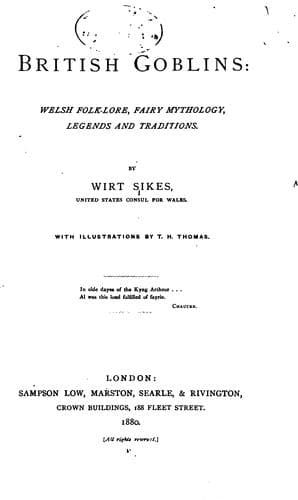
British Goblins: Welsh Folk-lore, Fairy Mythology, Legends and TraditionsSikes, Wirt
History
British Goblins: Welsh Folk-lore, Fairy Mythology, Legends and Traditions
Sikes, Wirt
Folklore -- Wales; Goblins -- Wales; Mythology, Celtic -- Wales; Mythology, Welsh; Wales -- Social life and customs
Many extraordinary superstitions survive with regard to these islands.
They were supposed to be the abode of the souls of certain Druids,
who, not holy enough to enter the heaven of the Christians, were still
not wicked enough to be condemned to the tortures of annwn, and so
were accorded a place in this romantic sort of purgatorial paradise.
In the fifth century a voyage was made, by the British king Gavran, in
search of these enchanted islands; with his family he sailed away into
the unknown waters, and was never heard of more. This voyage is
commemorated in the triads as one of the Three Losses by
Disappearance, the two others being Merlin's and Madog's. Merlin
sailed away in a ship of glass; Madog sailed in search of America; and
neither returned, but both disappeared for ever. In Pembrokeshire and
southern Carmarthenshire are to be found traces of this belief. There
are sailors on that romantic coast who still talk of the green meadows
of enchantment lying in the Irish channel to the west of
Pembrokeshire. Sometimes they are visible to the eyes of mortals for a
brief space, when suddenly they vanish. There are traditions of
sailors who, in the early part of the present century, actually went
ashore on the fairy islands--not knowing that they were such, until
they returned to their boats, when they were filled with awe at seeing
the islands disappear from their sight, neither sinking in the sea,
nor floating away upon the waters, but simply vanishing suddenly. The
fairies inhabiting these islands are said to have regularly attended
the markets at Milford Haven and Laugharne. They made their purchases
without speaking, laid down their money and departed, always leaving
the exact sum required, which they seemed to know, without asking the
price of anything. Sometimes they were invisible, but they were often
seen, by sharp-eyed persons. There was always one special butcher at
Milford Haven upon whom the fairies bestowed their patronage, instead
of distributing their favours indiscriminately. The Milford Haven
folk could see the green fairy islands distinctly, lying out a short
distance from land; and the general belief was that they were densely
peopled with fairies. It was also said that the latter went to and fro
between the islands and the shore through a subterranean gallery under
the bottom of the sea.
[Illustration: FAIRIES MARKETING AT LAUGHARNE.]
That isolated cape which forms the county of Pembroke was looked upon
as a land of mystery by the rest of Wales long after it had been
settled by the Flemings in 1113. A secret veil was supposed to cover
this sea-girt promontory; the inhabitants talked in an unintelligible
jargon that was neither English, nor French, nor Welsh; and out of its
misty darkness came fables of wondrous sort, and accounts of miracles
marvellous beyond belief. Mythology and Christianity spoke together
from this strange country, and one could not tell at which to be most
amazed, the pagan or the priest.
Public-domain text, read in full here on John Shaqi.
Reviews
Reviews
No reviews yet
Be the first to share your thoughts on this work.
Join the Discussion
Join the discussion
Sign in to leave a comment or review.
Sign InorCreate an account