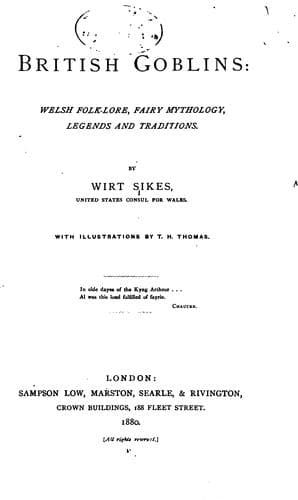
British Goblins: Welsh Folk-lore, Fairy Mythology, Legends and TraditionsSikes, Wirt
History
British Goblins: Welsh Folk-lore, Fairy Mythology, Legends and Traditions
Sikes, Wirt
Folklore -- Wales; Goblins -- Wales; Mythology, Celtic -- Wales; Mythology, Welsh; Wales -- Social life and customs
The modern Welsh name for fairies is y Tylwyth Teg, the fair folk or
family. This is sometimes lengthened into y Tylwyth Teg yn y Coed, the
fair family in the wood, or Tylwyth Teg y Mwn, the fair folk of the
mine. They are seen dancing in moonlight nights on the velvety grass,
clad in airy and flowing robes of blue, green, white, or
scarlet--details as to colour not usually met, I think, in accounts of
fairies. They are spoken of as bestowing blessings on those mortals
whom they select to be thus favoured; and again are called Bendith y
Mamau, or their mother's blessing, that is to say, good little
children whom it is a pleasure to know. To name the fairies by a harsh
epithet is to invoke their anger; to speak of them in flattering
phrase is to propitiate their good offices. The student of fairy
mythology perceives in this propitiatory mode of speech a fact of wide
significance. It can be traced in numberless lands, and back to the
beginning of human history, among the cloud-hung peaks of Central
Asia. The Greeks spoke of the furies as the Eumenides, or gracious
ones; Highlanders mentioned by Sir Walter Scott uncover to the gibbet
and call it 'the kind gallows;' the Dayak will not name the small-pox,
but calls it 'the chief;' the Laplander calls the bear 'the old man
with the fur coat;' in Ammam the tiger is called 'grandfather;' and it
is thought that the maxim, 'Speak only good of the dead,' came
originally from the notion of propitiating the ghost of the
departed,[9] who, in laying off this mortal garb, had become endowed
with new powers of harming his late acquaintance.
FOOTNOTES:
[8] 'Fairy Mythology' (Bohn's Ed.), 78.
[9] John Fiske, 'Myths and Myth-makers,' 223.
II.
The Ellyllon are the pigmy elves who haunt the groves and valleys, and
correspond pretty closely with the English elves. The English name was
probably derived from the Welsh _el_, a spirit, _elf_, an element;
there is a whole brood of words of this class in the Welsh language,
expressing every variety of flowing, gliding, spirituality, devilry,
angelhood, and goblinism. Ellyllon (the plural of ellyll), is also
doubtless allied with the Hebrew Elilim, having with it an identity
both of origin and meaning.[10] The poet Davydd ab Gwilym, in a
humorous account of his troubles in a mist, in the year 1340, says:
Yr ydoedd ym mhob gobant
Ellyllon mingeimion gant.
There was in every hollow
A hundred wrymouthed elves.
Public-domain text, read in full here on John Shaqi.
Reviews
Reviews
No reviews yet
Be the first to share your thoughts on this work.
Join the Discussion
Join the discussion
Sign in to leave a comment or review.
Sign InorCreate an account