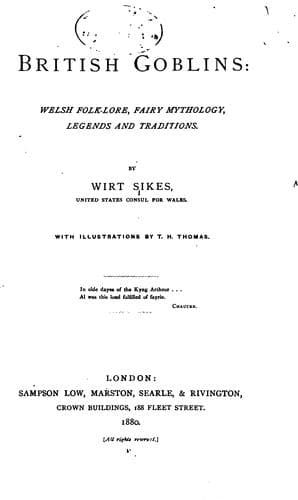
British Goblins: Welsh Folk-lore, Fairy Mythology, Legends and TraditionsSikes, Wirt
History
British Goblins: Welsh Folk-lore, Fairy Mythology, Legends and Traditions
Sikes, Wirt
Folklore -- Wales; Goblins -- Wales; Mythology, Celtic -- Wales; Mythology, Welsh; Wales -- Social life and customs
The hollows, or little dingles, are still the places where the
peasant, belated on his homeward way from fair or market, looks for
the ellyllon, but fails to find them. Their food is specified in Welsh
folk-lore as fairy butter and fairy victuals, ymenyn tylwyth teg and
bwyd ellyllon; the latter the toadstool, or poisonous mushroom, and
the former a butter-resembling substance found at great depths in the
crevices of limestone rocks, in sinking for lead ore. Their gloves,
menyg ellyllon, are the bells of the digitalis, or fox-glove, the
leaves of which are well known to be a strong sedative. Their
queen--for though there is no fairy-queen in the large sense that Gwyn
ap Nudd is the fairy-king, there is a queen of the elves--is none
other than the Shakspearean fairy spoken of by Mercutio, who comes
In shape no bigger than an agate-stone
On the forefinger of an alderman.[11]
Shakspeare's use of Welsh folk-lore, it should be noted, was extensive
and peculiarly faithful. Keightley in his 'Fairy Mythology' rates the
bard soundly for his inaccurate use of English fairy superstitions;
but the reproach will not apply as regards Wales. From his Welsh
informant Shakspeare got Mab, which is simply the Cymric for a little
child, and the root of numberless words signifying babyish, childish,
love for children (mabgar), kitten (mabgath), prattling (mabiaith),
and the like, most notable of all which in this connection is
mabinogi, the singular of Mabinogion, the romantic tales of
enchantment told to the young in by-gone ages.
FOOTNOTES:
[10] Pughe's 'Welsh Dictionary.' (Denbigh, 1866.)
[11] 'Romeo and Juliet,' Act II., Sc. 4.
III.
In the Huntsman's Rest Inn at Peterstone-super-Ely, near Cardiff, sat
a group of humble folk one afternoon, when I chanced to stop there to
rest myself by the chimney-side, after a long walk through green
lanes. The men were drinking their tankards of ale and smoking their
long clay pipes; and they were talking about their dogs and horses,
the crops, the hard times, and the prospect of bettering themselves by
emigration to America. On this latter theme I was able to make myself
interesting, and acquaintance was thereupon easily established on a
friendly footing. I led the conversation into the domain of folk-lore;
and this book is richer in illustration on many a page, in
consequence. Among others, this tale was told:
Public-domain text, read in full here on John Shaqi.
Reviews
Reviews
No reviews yet
Be the first to share your thoughts on this work.
Join the Discussion
Join the discussion
Sign in to leave a comment or review.
Sign InorCreate an account