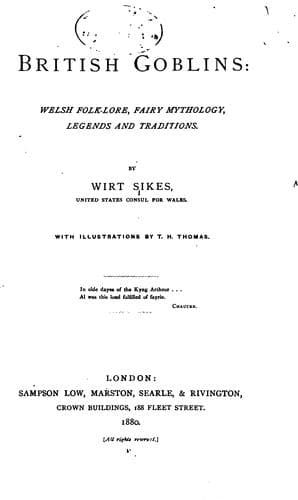
British Goblins: Welsh Folk-lore, Fairy Mythology, Legends and TraditionsSikes, Wirt
History
British Goblins: Welsh Folk-lore, Fairy Mythology, Legends and Traditions
Sikes, Wirt
Folklore -- Wales; Goblins -- Wales; Mythology, Celtic -- Wales; Mythology, Welsh; Wales -- Social life and customs
Surely, in this life, nothing! The student who endeavours to govern
his faith by the methods of science asks no more of any ghost that
ever walked the earth, than that it will prove itself a reality. Man
loves the marvellous. The marvels of science, however, do not melt
away into thin air on close examination. They thrive under the
severest tests, and grow more and more extraordinary the more they are
tried. The spectroscope and the radiometer are more wonderful than any
'supernatural' thing yet heard of. Transportation through the air in
the arms of a spirit is a clear impossibility; but it is less
wonderful than the every-day feats of electricity in our time, the
bare conception of which would have filled Plato and Aristotle with
awe.
The actual origin of the phantoms of the spirit-world is to be found
in the lawless and luxuriant fancy of primeval man. The creatures of
this fancy have been perpetuated throughout all time, unto our own
day, by that passionate yearning in men for continued life and love,
which is ineradicable in our nature. Men will not, they can not,
accept the doubt which plunges an eternal future into eternal
darkness, and separates them for ever from the creatures of their
love. Hence, when the remorseless fact of Death removes those
creatures, they look, with a longing which is indescribably pathetic,
into the Unknown where their beloved have gone, and strive to see them
in their spirit-life.
On this verge the finite mind must pause; to question that life is to
add a terrible burden to all human woe; it need not be questioned. But
to question the power of anything in that life to manifest itself to
man through natural law, is to do what science has a right to do. 'The
living know that they shall die: but the dead know not any thing ...
neither have they any more a portion for ever in any thing that is
done under the sun.'[112]
FOOTNOTE:
[112] 'Eccles.' ix., 5, 6.
[Illustration: {SPRIG OF LILY OF THE VALLEY.}]
BOOK III.
QUAINT OLD CUSTOMS.
Where in an agede cell with moss and iveye growne,
In which nor to this daye the sunn had ever showne,
Their reverend British saint, in zealous ages paste,
To contemplation lived, and did so truly faste,
As he did onlie drink what chrystal [rivers] yields,
And fed upon the leakes he gather'd in the fields:
In memory of whom, in the revolving year,
The Welchman on that daye that sacred herb doth wear.
_MS. in Bodleian Library._
CHAPTER I.
Public-domain text, read in full here on John Shaqi.
Reviews
Reviews
No reviews yet
Be the first to share your thoughts on this work.
Elsewhere in the archive
Join the Discussion
Join the discussion
Sign in to leave a comment or review.
Sign InorCreate an account