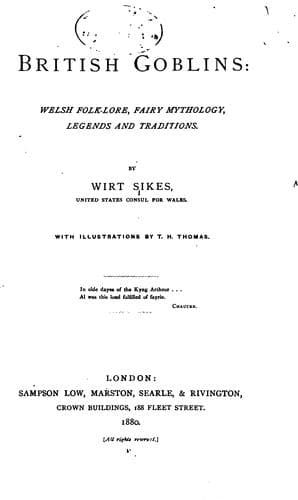
British Goblins: Welsh Folk-lore, Fairy Mythology, Legends and TraditionsSikes, Wirt
History
British Goblins: Welsh Folk-lore, Fairy Mythology, Legends and Traditions
Sikes, Wirt
Folklore -- Wales; Goblins -- Wales; Mythology, Celtic -- Wales; Mythology, Welsh; Wales -- Social life and customs
Serious Significance of seemingly Trivial Customs--Their
Origins--Common Superstitions--The Age we Live in--Days and
Seasons--New Year's Day--The Apple Gift--Lucky Acts on New
Year's Morning--The First Foot--Showmen's
Superstitions--Levy Dew Song--Happy New Year Carol--Twelfth
Night--The Mari Lwyd--The Penglog--The Cutty Wren--Tooling
and Sowling--St. Valentine's Day--St. Dewi's Day--The
Wearing of the Leek--The Traditional St. David--St.
Patrick's Day--St. Patrick a Welshman--Shrove Tuesday.
I.
Numberless customs in Wales which appear to be meaningless, to people
of average culture, are in truth replete with meaning. However trivial
they may seem, they are very seldom the offspring of mere fooling. The
student of comparative folk-lore is often able to trace their origin
with surprising distinctness, and to evolve from them a significance
before unsuspected. In many cases these quaint old customs are traced
to the primeval mythology. Others are clearly seen to be of Druidical
origin. Many spring from the rites and observances of the Roman
Catholic Church in the early days of Christianity on Welsh
soil--where, as is now generally conceded, the Gospel was first
preached in Great Britain. Some embody historical traditions; and some
are the outgrowth of peculiar states of society in medieval times.
Directly or indirectly, they are all associated with superstition,
though in many instances they have quite lost any superstitious
character in our day.
Public-domain text, read in full here on John Shaqi.
Reviews
Reviews
No reviews yet
Be the first to share your thoughts on this work.
Elsewhere in the archive
Join the Discussion
Join the discussion
Sign in to leave a comment or review.
Sign InorCreate an account