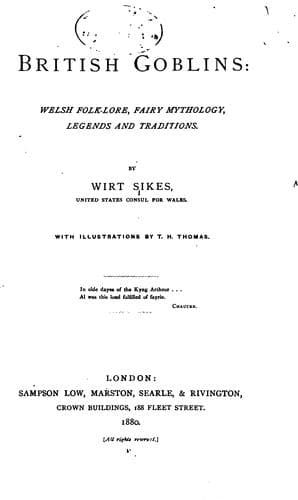
British Goblins: Welsh Folk-lore, Fairy Mythology, Legends and TraditionsSikes, Wirt
History
British Goblins: Welsh Folk-lore, Fairy Mythology, Legends and Traditions
Sikes, Wirt
Folklore -- Wales; Goblins -- Wales; Mythology, Celtic -- Wales; Mythology, Welsh; Wales -- Social life and customs
Modern society is agreed, with respect to many curious old customs, to
view them as the peculiar possession of ignorance. It is very
instructive to note, in this connection, how blandly we accept some of
the most superstitious of these usages, with tacit approval, and
permit them to govern our conduct. In every civilised community, in
every enlightened land on earth, there are many men and women to whom
this remark applies, who would deem themselves shamefully insulted
should you doubt their intelligence and culture. Men and women who
'smile superior' at the idea of Luther hurling inkstands at the devil,
or at the Welsh peasant who thinks a pig can see the wind, will
themselves avoid beginning a journey on a Friday, view as ominous a
rainy wedding-day, throw an old slipper after a bride for luck,
observe with interest the portents of their nightly dreams, shun
seeing the new moon over the left shoulder, throw a pinch of salt over
the same member when the salt-cellar is upset, tie a red string about
the neck to cure nose-bleed, and believe in the antics of the modern
spiritualistic 'control.' Superstition, however, they leave to the
ignorant! The examples of every-day fetichism here cited are familiar
to us, not specially among the Welsh, but among the English also, and
the people of the United States--who, I may again observe, are no
doubt as a people uncommonly free from superstition, in comparison
with the older nations of the earth; but modesty is a very becoming
wear for us all, in examining into other people's superstitions.
Aside from their scientific interest, there is a charm about many of
the quaint customs of the Welsh, which speaks eloquently to most
hearts. They are the offspring of ignorance, true, but they touch the
'good old times' of the poet and the romancer, when the conditions of
life were less harsh than now. So we love to think. As a matter of
scientific truth, this idea is itself, alas! but a superstition. This
world has probably never been so fair a place to live in, life never
so free from harsh conditions, as now; and as time goes on, there can
be no doubt the improving process will continue. The true halcyon days
of man are to be looked for in the future--not in the past; but with
that future we shall have no mortal part.
II.
In treating of customs, no other classification is needful than their
arrangement in orderly sequence in two divisions: first, those which
pertain to certain days and seasons; second, those relating to the
most conspicuous events in common human life, courtship, marriage, and
death.
Public-domain text, read in full here on John Shaqi.
Reviews
Reviews
No reviews yet
Be the first to share your thoughts on this work.
Elsewhere in the archive
Join the Discussion
Join the discussion
Sign in to leave a comment or review.
Sign InorCreate an account