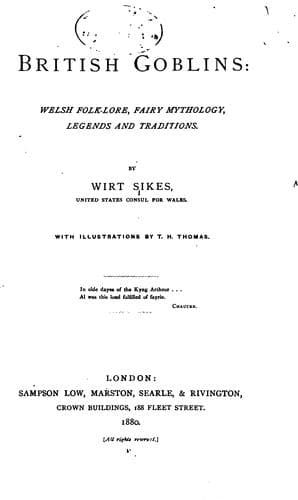
British Goblins: Welsh Folk-lore, Fairy Mythology, Legends and TraditionsSikes, Wirt
History
British Goblins: Welsh Folk-lore, Fairy Mythology, Legends and Traditions
Sikes, Wirt
Folklore -- Wales; Goblins -- Wales; Mythology, Celtic -- Wales; Mythology, Welsh; Wales -- Social life and customs
The traditional St. David is a brilliant figure in Welsh story; with
the historical character this work has not to deal. The legendary
account of him represents a man of gigantic stature and fabulous
beauty, whose age at his death was 147 years. He was a direct
descendant of the sister of the Virgin Mary, and his first miracles
were performed while he was yet unborn. In this condition he regulated
the diet of his virgin mother, and struck dumb a preacher who
presumed to preach in her presence. At the hour of his birth St. Dewi
performed a miracle; another when he was baptized; and he was taught
his lessons (at a place called The Old Bush, in South Wales) by a
pigeon with a golden beak, which played about his lips. As he grew up,
his miraculous powers waxed stronger; and magicians who opposed him
were destroyed by fire which he called from heaven to consume them.
Thirsty, a fountain rose in Glyn Hodnant at his call, and from this
fountain ran not water but good wine. When he went about the country
he was always accompanied by an angel. On the banks of the river
Teify, a miserable woman wept over her son who lay dead; she appealed
to Dewi, who laid hold of the boy's right hand and he arose from the
dead as if from a sleep. At Llandewi Brefi, in Cardiganshire, as he
was preaching on the surface of the flat ground, the ground rose as a
high mount under his feet, so that the people all about could see him
as well as hear him. A labourer lifted his pickaxe to strike a friend
of Dewi's, which the saint seeing from afar off, raised his hand and
willed that the labourer's hand should become stiff--which it did.
Another friend, going away to Ireland, forgot and left behind him a
little bell that Dewi had given him; but Dewi sent the bell across the
sea by an angel, so that it arrived there next day without the aid of
human hands. And finally, having made up his mind that he would die
and go to heaven, he did so--but quite of his own will--at his own
request, so to speak. Having asked that his soul might be taken, an
angel informed him it would be taken on the first of March proximo. So
David bade his friends good-bye on the 28th of February, greatly to
their distress. 'Alas!' they cried, 'the earth will not swallow us!
Alas! fire will not consume us! Alas! the sea will not come over the
land! Alas! the mountains will not fall to cover us!' On Tuesday
night, as the cocks were crowing, a host of angels thronged the
streets of the city, and filled it with joy and mirth; and Dewi died.
'The angels took his soul to the place where there is light without
end, and rest without labour, and joy without sorrow, and plenty of
all good things, and victory, and brightness, and beauty.' There Abel
is with the martyrs, Noah is with the sailors, Thomas is with the
Indians, Peter is with the apostles, Paul is with the Greeks, other
saints are with other suitable persons, and David is with the
kings.[119]
Public-domain text, read in full here on John Shaqi.
Reviews
Reviews
No reviews yet
Be the first to share your thoughts on this work.
Elsewhere in the archive
Join the Discussion
Join the discussion
Sign in to leave a comment or review.
Sign InorCreate an account