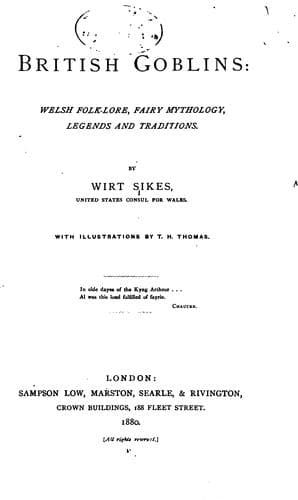
British Goblins: Welsh Folk-lore, Fairy Mythology, Legends and TraditionsSikes, Wirt
History
British Goblins: Welsh Folk-lore, Fairy Mythology, Legends and Traditions
Sikes, Wirt
Folklore -- Wales; Goblins -- Wales; Mythology, Celtic -- Wales; Mythology, Welsh; Wales -- Social life and customs
On the summit which rose under St. Dewi while he stood on it and
preached, now stands St. David's church, at Llandewi Brefi. In the
days of its glory--i.e. during nearly the whole period of Roman
Catholic rule--it was renowned beyond all others in Britain. To go
twice to St. David's was deemed equal to going once to Rome, and a
superstitious belief prevailed that every man must go to St. David's
once, either alive or dead. William the Conqueror marched through
Wales in hostile array in 1080, but arriving at St. David's shrine
laid aside the warrior for the votary.
FOOTNOTE:
[119] 'Cambro-British Saints,' 402, etc.
VII.
St. Patrick's Day is celebrated in Wales with much enthusiasm. The
Welsh believe that St. Patrick was a Welshman. Born at Llandeilo
Talybont, in Glamorganshire, and educated at the famous college of
Llantwit Major, he held St. David's place till the coming of Dewi was
announced to him; then he went into Ireland, to do missionary work,
as it were. This is the monastic tale. Patrick was comfortably settled
in the valley of Rosina, and intended to pass his life there, but an
angel came to him and said, 'Thou must leave this place to one who is
not yet born.' Patrick was annoyed, even angered, but obedient, and
went off to Ireland, where he became a great man.[120] The story of
the Iolo MSS., however, presents the matter in a different light:
'About A.D. 420 the Island of Britain seemed to have neither ruler nor
proprietor.' The Irish took advantage of this state of things to
invade and oppress Britain, robbing her of corn, cattle, 'and every
other moveable property that they could lay their hands on.' Among
other things, they stole away St. Patrick from the college at Llantwit
Major, 'whence that college became destitute of a principal and
teacher for more than forty years, and fell into dilapidation'--a
condition it remains in at present, by the way. 'Patrick never
returned to Wales, choosing rather to reside in Ireland; having
ascertained that the Irish were better people than the Welsh, in those
times.'[121] Still, it is not the native Welsh who are as a rule the
celebrators of St. Patrick's Day in Wales.
FOOTNOTES:
[120] 'Cambro-British Saints,' 403.
[121] Iolo MSS., 455.
VIII.
Shrove Tuesday was once characterised by a custom called throwing at
cocks, now obsolete. Hens which had laid no eggs before that day were
threshed with a flail, as being good for nothing. The person who hit
the hen with the flail and killed her got her for his reward.
The more reputable custom of cramming with crammwythau (pancakes)
still survives, and is undoubtedly of extreme antiquity.
CHAPTER II.
Public-domain text, read in full here on John Shaqi.
Reviews
Reviews
No reviews yet
Be the first to share your thoughts on this work.
Elsewhere in the archive
Join the Discussion
Join the discussion
Sign in to leave a comment or review.
Sign InorCreate an account