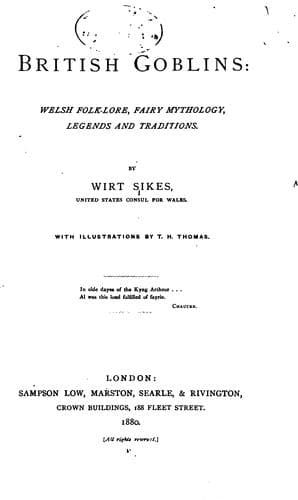
British Goblins: Welsh Folk-lore, Fairy Mythology, Legends and TraditionsSikes, Wirt
History
British Goblins: Welsh Folk-lore, Fairy Mythology, Legends and Traditions
Sikes, Wirt
Folklore -- Wales; Goblins -- Wales; Mythology, Celtic -- Wales; Mythology, Welsh; Wales -- Social life and customs
Sundry Lenten Customs--Mothering Sunday--Palm
Sunday--Flowering Sunday--Walking Barefoot to
Church--Spiritual Potency of Buns--Good Friday
Superstitions--Making Christ's Bed--Bad Odour of
Friday--Unlucky Days--Holy Thursday--The Eagle of
Snowdon--New Clothing at Easter--Lifting--The Crown of
Porcelain--Stocsio--Ball-Playing in Churchyards--The Tump of
Lies--Dancing in Churchyards--Seeing the Sun Dance--Calan
Ebrill, or All Fools' Day--May Day--The Welsh Maypole--The
Daughter of Lludd Llaw Ereint--Carrying the Kings of Summer
and Winter.
I.
Wearing mourning throughout Lent was formerly common in Wales. In
Monmouthshire, Mothering Sunday--the visiting of parents on Mid-Lent
Sunday--was observed in the last century, but is nowhere popular in
Wales at present. Palm Sunday takes precedence among the Welsh, and is
very extensively and enthusiastically observed. The day is called
Flowering Sunday, and its peculiar feature is strewing the graves of
the dead with flowers. The custom reaches all classes, and all parts
of the Principality. In the large towns, as Cardiff, many thousands of
people gather at the graves. The custom is associated with the
strewing of palms before Christ on his entry into Jerusalem, but was
observed by the British Druids in celebration of the awakening life of
the earth at this season.
II.
In Pembrokeshire, it was customary up to the close of the last
century, to walk barefoot to church on Good Friday, as had been done
since times prior to the Reformation. The old people and the young
joined in this custom, which they said was done so as not to 'disturb
the earth.' All business was suspended, and no horse nor cart was to
be seen in the town.
Hot-cross buns also figured in a peculiar manner at this time. They
were eaten in Tenby after the return from church. After having tied up
a certain number in a bag, the folk hung them in the kitchen, where
they remained till the next Good Friday, for use as medicine. It was
believed that persons labouring under any disease had only to eat a
portion of a bun to be cured. The buns so preserved were used also as
a panacea for all the diseases of domestic animals. They were further
believed to be serviceable in frightening away goblins of an evil
sort.
That these buns are of Christian invention is the popular belief, and
indeed this notion is not altogether exploded among the more
intelligent classes. Their connection with the cross of the Saviour is
possible by adoption--as the early Christians adopted many pagan rites
and customs--but that they date back to pre-historic times there is
abundant testimony.
Public-domain text, read in full here on John Shaqi.
Reviews
Reviews
No reviews yet
Be the first to share your thoughts on this work.
Elsewhere in the archive
Join the Discussion
Join the discussion
Sign in to leave a comment or review.
Sign InorCreate an account