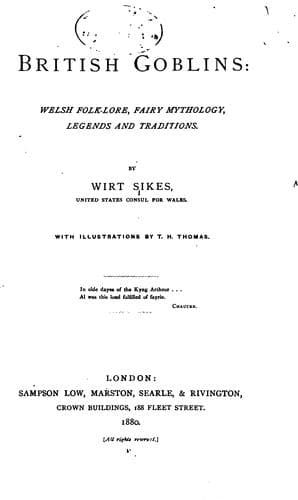
British Goblins: Welsh Folk-lore, Fairy Mythology, Legends and TraditionsSikes, Wirt
History
British Goblins: Welsh Folk-lore, Fairy Mythology, Legends and Traditions
Sikes, Wirt
Folklore -- Wales; Goblins -- Wales; Mythology, Celtic -- Wales; Mythology, Welsh; Wales -- Social life and customs
Innumerable are the superstitious customs and beliefs associated with
Good Friday. In Pembrokeshire there was a custom called 'making
Christ's bed.' A quantity of long reeds were gathered from the river
and woven into the shape of a man. This effigy was then stretched on a
wooden cross, and laid in some retired field or garden, and left
there.
The birth of a child on that day is very unlucky--indeed a birth on
any Friday of the whole year is to be deprecated as a most unfortunate
circumstance.
III.
The bad odour in which Friday is everywhere held is naturally
associated, among Christians, with the crucifixion; but this will not
account for the existence of a like superstition regarding Friday
among the Brahmins of India, nor for the prevalence of other lucky and
unlucky days among both Aryan and Mongolian peoples. In the Middle
Ages Monday and Tuesday were unlucky days. A Welshman who lived some
time in Russia, tells me Monday is deemed a very unlucky day there, on
which no business must be begun. In some English districts Thursday is
the unlucky day. In Norway it is lucky, especially for marrying. In
South Wales, Friday is the fairies' day, when they have special
command over the weather; and it is their whim to make the weather on
Friday differ from that of the other days of the week. 'When the rest
of the week is fair, Friday is apt to be rainy, or cloudy; and when
the weather is foul, Friday is apt to be more fair.'
The superstitious prejudice of the quarrymen in North Wales regarding
Holy Thursday has been cited. It is not a reverential feeling, but a
purely superstitious one, and has pervaded the district from ancient
times. It has been supposed that Thursday was a sacred day among the
Druids. There is a vulgar tradition (mentioned by Giraldus), that
Snowdon mountains are frequented by an eagle, which perches on a fatal
stone on every Thursday and whets her beak upon it, expecting a battle
to occur, upon which she may satiate her hunger with the carcases of
the slain; but the battle is ever deferred, and the stone has become
almost perforated with the eagle's sharpening her beak upon it. There
may perhaps be a connection traced between these superstitions and the
lightning-god Thor, whose day Thursday was.
IV.
Public-domain text, read in full here on John Shaqi.
Reviews
Reviews
No reviews yet
Be the first to share your thoughts on this work.
Elsewhere in the archive
Join the Discussion
Join the discussion
Sign in to leave a comment or review.
Sign InorCreate an account