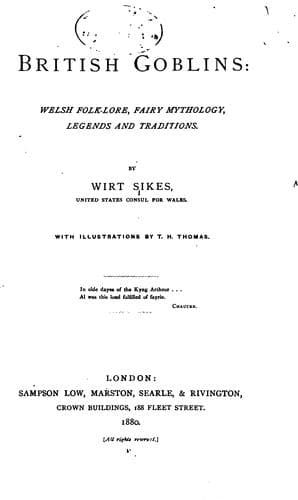
British Goblins: Welsh Folk-lore, Fairy Mythology, Legends and TraditionsSikes, Wirt
History
British Goblins: Welsh Folk-lore, Fairy Mythology, Legends and Traditions
Sikes, Wirt
Folklore -- Wales; Goblins -- Wales; Mythology, Celtic -- Wales; Mythology, Welsh; Wales -- Social life and customs
Easter is marked by some striking customs. It is deemed essential for
one's well-being that some new article of dress shall be donned at
this time, though it be nothing more than a new ribbon. This is also a
Hampshire superstition. A servant of mine, born in Hampshire, used
always to say, 'If you don't have on something new Easter Sunday the
dogs will spit at you.' This custom is associated with Easter baptism,
when a new life was assumed by the baptized, clothed in righteousness
as a garment. A ceremony called 'lifting' is peculiar to North Wales
on Easter Monday and Tuesday. On the Monday bands of men go about with
a chair, and meeting a woman in the street compel her to sit, and be
lifted three times in the air amidst their cheers: she is then invited
to bestow a small compliment on her entertainers. This performance is
kept up till twelve o'clock, when it ceases. On Easter Tuesday the
women take their turn, and go about in like manner lifting the men. It
has been conjectured that in this custom an allusion to the
resurrection is intended.
[Illustration: LIFTING. (_From an old drawing._)]
A custom, the name of which is now lost, was that the village belle
should on Easter Eve and Easter Tuesday carry on her head a piece of
chinaware of curious shape, made expressly for this purpose, and
useless for any other. It may be described as a circular crown of
porcelain, the points whereof were cups and candles. The cups were
solid details of the crown: the candles were stuck with clay upon the
spaces between the cups. The cups were filled with a native beverage
called bragawd, and the candles were lighted. To drink the liquor
without burning yourself or the damsel at the candle was the
difficulty involved in this performance. A stanza was sung by the
young woman's companions, the last line of which was,
Rhag i'r feinwen losgi ei thalcen.
(Lest the maiden burn her forehead.[122])
Public-domain text, read in full here on John Shaqi.
Reviews
Reviews
No reviews yet
Be the first to share your thoughts on this work.
Elsewhere in the archive
Join the Discussion
Join the discussion
Sign in to leave a comment or review.
Sign InorCreate an account