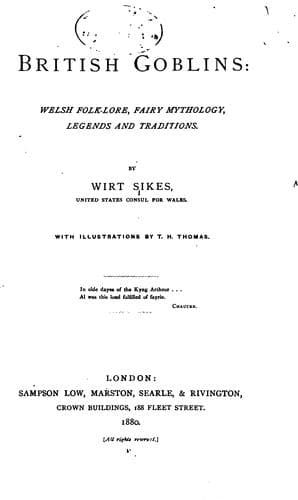
British Goblins: Welsh Folk-lore, Fairy Mythology, Legends and TraditionsSikes, Wirt
History
British Goblins: Welsh Folk-lore, Fairy Mythology, Legends and Traditions
Sikes, Wirt
Folklore -- Wales; Goblins -- Wales; Mythology, Celtic -- Wales; Mythology, Welsh; Wales -- Social life and customs
Stocsio is an Easter Monday custom observed from time immemorial in
the town of Aberconwy, and still practised there in 1835. On Easter
Sunday crowds of men and boys carrying wands of gorse went to Pen
Twthil, and there proclaimed the laws and regulations of the following
day. They were to this effect: all men under sixty to be up and out
before 6 A.M.; all under forty, before 4 A.M.; all under twenty, to
stay up all night. Penalty for disobedience: the stocks. The crier who
delivered this proclamation was the man last married in the town
previous to Easter Sunday. Other like rules were proclaimed, amid loud
cheers. Early next morning a party, headed by a fife and drum,
patrolled the town with a cart, in search of delinquents. When one was
discovered, he was hauled from his bed and made to dress himself; then
put in the cart and dragged to the stocks. His feet being secured
therein, he was duly lectured on the sin of laziness, and of breaking
an ancient law of the town by lying abed in violation thereof. His
right hand was then taken, and he was asked a lot of absurd questions,
such as 'Which do you like best, the mistress or the maid?' 'Which do
you prefer, ale or buttermilk?' 'If the gate of a field were open,
would you go through it, or over the stile?' and the like. His answers
being received with derision, his hand was smeared with mud, and he
was then released amid cheers. 'This sport, which would be
impracticable in a larger and less intimate community, is continued
with the greatest good humour until eight; when the rest of the day is
spent in playing ball at the Castle.'[123]
FOOTNOTES:
[122] 'Arch. Camb.' 4 Se., iii., 334.
[123] 'Hist. and Ant. of Aberconwy,' 108.
V.
Ball-playing against the walls of the church between hours of service
was a fashion of Easter which is within recollection. It was also
common on the Sabbath day itself in many parishes, in the days when
dissent was unknown and parishioners had long distances to traverse on
a Sunday; 'and that, too, with the sanction of the clergyman, and even
his personal superintendence. Old people can remember such a state of
things, when the clergyman gave notice that the game must cease by
putting the ball into his pocket and marched his young friends into
church.'[124] Nowhere less than in a custom like this would the
ordinary observer look for traditionary significance; yet there is no
doubt our Easter eggs are but another surviving form of the same
ancient rite. Before the Reformation there was a Church of England
custom of playing ball _in_ church at Easter, according to Dr.
Fosbrooke, the dean and clergy participating.
Public-domain text, read in full here on John Shaqi.
Reviews
Reviews
No reviews yet
Be the first to share your thoughts on this work.
Elsewhere in the archive
Join the Discussion
Join the discussion
Sign in to leave a comment or review.
Sign InorCreate an account