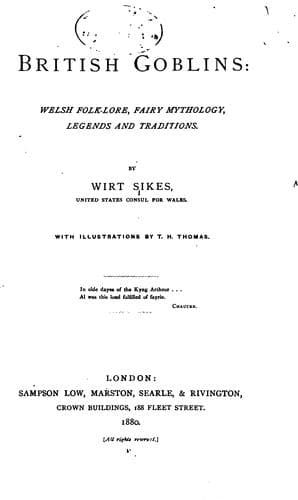
British Goblins: Welsh Folk-lore, Fairy Mythology, Legends and TraditionsSikes, Wirt
History
British Goblins: Welsh Folk-lore, Fairy Mythology, Legends and Traditions
Sikes, Wirt
Folklore -- Wales; Goblins -- Wales; Mythology, Celtic -- Wales; Mythology, Welsh; Wales -- Social life and customs
The Welsh saint called Cynog was one of the numberless children of
that famous old patriarch Brychan Brycheiniog, and had his memory
honoured, until a comparatively recent period, in the parish of
Defynog. Here, on this saint's feast Monday, which fell in October,
there was a custom called 'carrying Cynog.' Cynog was represented by a
man who was paid for his services with money, or with a suit of
clothes--sometimes a 'stranger' from an adjoining parish, but on the
last recorded occasion a drunken farmer of the neighbourhood. He was
clad in dilapidated garments, and borne through the village; after
which he was tumbled headlong into the river amid the jeers of the
crowd, to scramble out as best he might. It was not a very respectful
way of commemorating a saint who had been buried a thousand years or
thereabouts; but such as it was it died out early in the present
century. The ducking which ended the performance has been supposed to
be a puritan improvement on what was before a religious ceremony, or
mystery. It is more than possibly a relic of the Druidic sacrificial
rites; in cases where a river ran near, at the time of the Beltane
fires, a sacrifice by water was substituted for that of flame.
The feast of St. Cynog continued for a week. On the Tuesday there was
a singular marketing in the churchyard; from all about the farmers
brought their tithe of cheese, and taking it to the churchyard, laid
it on the tombstones, where it was sold for the parson's behoof.
IV.
All Hallows eve is by the Welsh called 'Nos Calan Gauaf,' meaning 'the
first night of winter;' sometimes, 'Nos Cyn Gauaf,' the 'night before
winter.' It is one of the 'Teir Nos Ysprydnos,' or 'three nights for
spirits,' upon which ghosts walk, fairies are abroad, mysterious
influences are in the air, strange sights are seen, and in short
goblins of every sort are to be with special freedom encountered. They
may be conjured to appear, by certain enchantments, and to give their
visitors glimpses of the future, especially as regards the subject of
marrying. On this night it is customary for the young people,
gathered in many a merry circle, to seek by tricks and charms of
various sort to become acquainted with their future lovers and
sweethearts. Not that it is always necessary to employ such aids, for
on the Teir Nos Ysprydnos the phantoms of future companions have been
known to appear unsummoned. There are many such stories as that of
Thomas Williams, the preacher, who slept in the hills on a Nos
Ysprydnos, and although he used no charms nor tricks of any sort, he
saw his future wife. As he was just about putting out his light,
having jumped into bed, the door opened and the goblin mother of the
young woman he subsequently married walked into the room, leading her
daughter. 'Here, Thomas,' said she, 'I am going, but I leave you
Mary.' And when he came down home out of the mountains he found that
the old mother had died in her bed at the very moment he saw her
goblin.
Public-domain text, read in full here on John Shaqi.
Reviews
Reviews
No reviews yet
Be the first to share your thoughts on this work.
Elsewhere in the archive
Join the Discussion
Join the discussion
Sign in to leave a comment or review.
Sign InorCreate an account