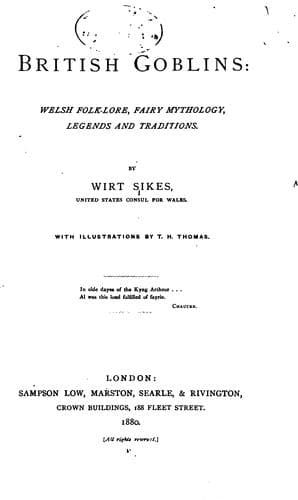
British Goblins: Welsh Folk-lore, Fairy Mythology, Legends and TraditionsSikes, Wirt
History
British Goblins: Welsh Folk-lore, Fairy Mythology, Legends and Traditions
Sikes, Wirt
Folklore -- Wales; Goblins -- Wales; Mythology, Celtic -- Wales; Mythology, Welsh; Wales -- Social life and customs
The Gwragedd Annwn (literally, wives of the lower world, or hell) are
the elfin dames who dwell under the water. I find no resemblance in
the Welsh fairy to our familiar mermaid, beyond the watery abode, and
the sometimes winning ways. The Gwragedd Annwn are not fishy of
aspect, nor do they dwell in the sea. Their haunt is the lakes and
rivers, but especially the wild and lonely lakes upon the mountain
heights. These romantic sheets are surrounded with numberless
superstitions, which will be further treated of. In the realm of
faerie they serve as avenues of communication between this world and
the lower one of annwn, the shadowy domain presided over by Gwyn ap
Nudd, king of the fairies. This sub-aqueous realm is peopled by those
children of mystery termed Plant Annwn, and the belief is current
among the inhabitants of the Welsh mountains that the Gwragedd Annwn
still occasionally visit this upper world of ours.[23] The only
reference to Welsh mermaids I have either read or heard is contained
in Drayton's account of the Battle of Agincourt. There it is
mentioned, among the armorial ensigns of the counties of Wales:
As Cardigan, the next to them that went,
Came with a mermaid sitting on a rock.[24]
FOOTNOTES:
[23] 'Archæologia Cambrensis,' 2nd Se., iv., 253.
[24] There is in 'Cymru Fu' a mermaid story, but its mermaid feature
is apparently a modern embellishment of a real incident, and without
value here.
II.
Crumlyn Lake, near the quaint village of Briton Ferry, is one of the
many in Wales which are a resort of the elfin dames. It is also
believed that a large town lies swallowed up there, and that the
Gwragedd Annwn have turned the submerged walls to use as the
superstructure of their fairy palaces. Some claim to have seen the
towers of beautiful castles lifting their battlements beneath the
surface of the dark waters, and fairy bells are at times heard ringing
from these towers. The way the elfin dames first came to dwell there
was this: A long, ay, a very long time ago, St. Patrick came over from
Ireland on a visit to St. David of Wales, just to say 'Sut yr y'ch
chwi?' (How d'ye do?); and as they were strolling by this lake
conversing on religious topics in a friendly manner, some Welsh people
who had ascertained that it was St. Patrick, and being angry at him
for leaving Cambria for Erin, began to abuse him in the Welsh
language, his native tongue. Of course such an insult could not go
unpunished, and St. Patrick caused his villifiers to be transformed
into fishes; but some of them being females, were converted into
fairies instead. It is also related that the sun, on account of this
insolence to so holy a man, never shed its life-giving rays upon the
dark waters of this picturesque lake, except during one week of the
year. This legend and these magical details are equally well
accredited to various other lakes, among them Llyn Barfog, near
Aberdovey, the town whose 'bells' are celebrated in immortal song.
III.
Public-domain text, read in full here on John Shaqi.
Reviews
Reviews
No reviews yet
Be the first to share your thoughts on this work.
Join the Discussion
Join the discussion
Sign in to leave a comment or review.
Sign InorCreate an account