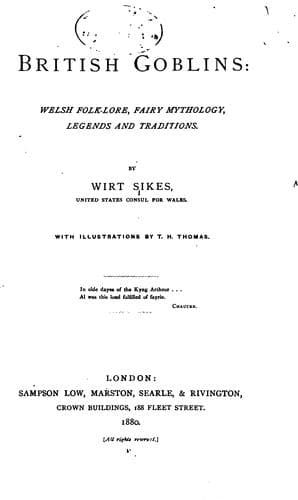
British Goblins: Welsh Folk-lore, Fairy Mythology, Legends and TraditionsSikes, Wirt
History
British Goblins: Welsh Folk-lore, Fairy Mythology, Legends and Traditions
Sikes, Wirt
Folklore -- Wales; Goblins -- Wales; Mythology, Celtic -- Wales; Mythology, Welsh; Wales -- Social life and customs
The harp is played by Welsh fairies to an extent unknown in those
parts of the world where the harp is less popular among the people.
When any instrument is distinctly heard in fairy cymmoedd it is
usually the harp. Sometimes it is a fiddle, but then on close
examination it will be discovered that it is a captured mortal who is
playing it; the Tylwyth Teg prefer the harp. They play the bugle on
specially grand occasions, and there is a case or two on record where
the drone of the bagpipes was heard; but it is not doubted that the
player was some stray fairy from Scotland or elsewhere over the
border. On the top of Craig-y-Ddinas thousands of white fairies dance
to the music of many harps. In the dingle called Cwm Pergwm, in the
Vale of Neath, the Tylwyth Teg make music behind the waterfall, and
when they go off over the mountains the sounds of their harps are
heard dying away as they recede. The story which presents the Cambrian
equivalent of the Magic Flute substitutes a harp for the (to
Welshmen) less familiar instrument. As told to me this story runs
somewhat thus: A company of fairies which frequented Cader Idris were
in the habit of going about from cottage to cottage in that part of
Wales, in pursuit of information concerning the degree of benevolence
possessed by the cottagers. Those who gave these fairies an ungracious
welcome were subject to bad luck during the rest of their lives, but
those who were good to the little folk became the recipients of their
favour. Old Morgan ap Rhys sat one night in his own chimney corner
making himself comfortable with his pipe and his pint of cwrw da. The
good ale having melted his soul a trifle, he was in a more jolly mood
than was natural to him, when there came a little rap at the door,
which reached his ear dully through the smoke of his pipe and the
noise of his own voice--for in his merriment Morgan was singing a
roystering song, though he could not sing any better than a haw--which
is Welsh for a donkey. But Morgan did not take the trouble to get up
at sound of the rap; his manners were not the most refined; he thought
it was quite enough for a man on hospitable purposes bent to bawl
forth in ringing Welsh, 'Gwaed dyn a'i gilydd! Why don't you come in
when you've got as far as the door?' The welcome was not very polite,
but it was sufficient. The door opened, and three travellers entered,
looking worn and weary. Now these were the fairies from Cader Idris,
disguised in this manner for purposes of observation, and Morgan never
suspected they were other than they appeared. 'Good sir,' said one of
the travellers, 'we are worn and weary, but all we seek is a bite of
food to put in our wallet, and then we will go on our way.' 'Waw,
lads! is that all you want? Well, there, look you, is the loaf and the
cheese, and the knife lies by them, and you may cut what you like, and
fill your bellies as well as your wallet, for never shall it be said
Public-domain text, read in full here on John Shaqi.
Reviews
Reviews
No reviews yet
Be the first to share your thoughts on this work.
Elsewhere in the archive
Join the Discussion
Join the discussion
Sign in to leave a comment or review.
Sign InorCreate an account