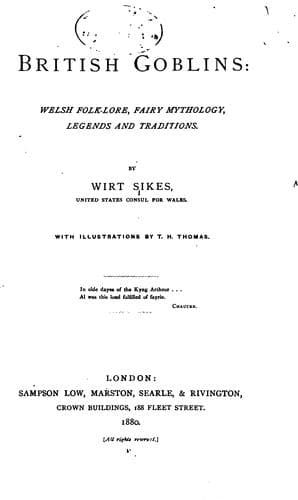
British Goblins: Welsh Folk-lore, Fairy Mythology, Legends and TraditionsSikes, Wirt
History
British Goblins: Welsh Folk-lore, Fairy Mythology, Legends and Traditions
Sikes, Wirt
Folklore -- Wales; Goblins -- Wales; Mythology, Celtic -- Wales; Mythology, Welsh; Wales -- Social life and customs
one night the good people came and took it away from him, and he never
saw it more. The consequence was he became morose, and drank himself
to death--a warning to all who accept from the fairies favours they do
not deserve.
III.
The music of the Tylwyth Teg has been variously described by people
who claim to have heard it; but as a rule with much vagueness, as of a
sweet intangible harmony, recalling the experience of Caliban:
The isle is full of noises;
Sounds, and sweet airs, that give delight, and hurt not.
Sometimes a thousand twangling instruments
Will hum about mine ears.[48]
One Morgan Gwilym, who saw the fairies by Cylepsta Waterfall, and
heard their music dying away, was only able to recall the last strain,
which he said sounded something like this:
[Music]
Edmund Daniel, of the Arail, 'an honest man and a constant speaker of
truth,' told the Prophet Jones that he often saw the fairies after
sunset crossing the Cefn Bach from the Valley of the Church towards
Hafodafel, leaping and striking in the air, and making a serpentine
path through the air, in this form:
[Illustration: {WAVY HORIZONTAL LINE.}]
The fairies were seen and heard by many persons in that neighbourhood,
and sometimes by several persons together. They appeared more often by
night than by day, and in the morning and evening more often than
about noon. Many heard their music, and said of it that it was low and
pleasant; but that it had this peculiarity: no one could ever learn
the tune. In more favoured parts of the Principality, the words of the
song were distinctly heard, and under the name of the 'Cân y Tylwyth
Teg' are preserved as follows:
Dowch, dowch, gyfeillion mân,
O blith marwolion byd,
Dowch, dowch, a dowch yn lân.
Partowch partowch eich pibau cân,
Gan ddawnsio dowch i gyd,
Mae yn hyfryd heno i hwn.
One is reluctant to turn into bald English this goblin song, which in
its native Welsh is almost as impressive as 'Fi Fo Fum.' Let it
suffice that the song is an invitation to the little ones among the
dead of earth to come with music and dancing to the delights of the
night revel.
FOOTNOTE:
[48] 'Tempest,' Act III., Sc. 2.
IV.
Public-domain text, read in full here on John Shaqi.
Reviews
Reviews
No reviews yet
Be the first to share your thoughts on this work.
Elsewhere in the archive
Join the Discussion
Join the discussion
Sign in to leave a comment or review.
Sign InorCreate an account