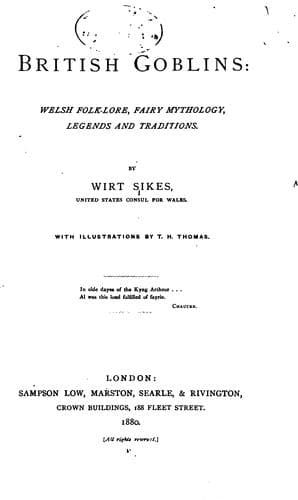
British Goblins: Welsh Folk-lore, Fairy Mythology, Legends and TraditionsSikes, Wirt
History
British Goblins: Welsh Folk-lore, Fairy Mythology, Legends and Traditions
Sikes, Wirt
Folklore -- Wales; Goblins -- Wales; Mythology, Celtic -- Wales; Mythology, Welsh; Wales -- Social life and customs
In the legend of Iolo ap Hugh, than which no story is more widely
known in Wales, the fairy origin of that famous tune 'Ffarwel Ned
Pugh' is shown. It is a legend which suggests the Enchanted Flute
fancy in another form, the instrument here being a fiddle, and the
victim and player one under fairy control. In its introduction of
bread and cheese and candles it smacks heartily of the soil. In North
Wales there is a famous cave which is said to reach from its entrance
on the hillside 'under the Morda, the Ceiriog, and a thousand other
streams, under many a league of mountain, marsh and moor, under the
almost unfathomable wells that, though now choked up, once supplied
Sycharth, the fortress of Glyndwrdwy, all the way to Chirk Castle.'
Tradition said that whoever went within five paces of its mouth would
be drawn into it and lost. That the peasants dwelling near it had a
thorough respect for this tradition, was proved by the fact that all
around the dangerous hole 'the grass grew as thick and as rank as in
the wilds of America or some unapproached ledge of the Alps.' Both men
and animals feared the spot: 'A fox, with a pack of hounds in full cry
at his tail,' once turned short round on approaching it, 'with his
hair all bristled and fretted like frostwork with terror,' and ran
into the middle of the pack, 'as if anything earthly--even an earthly
death--was a relief to his supernatural perturbations.' And the dogs
in pursuit of this fox all declined to seize him, on account of the
phosphoric smell and gleam of his coat. Moreover, 'Elias ap Evan, who
happened one fair night to stagger just upon the rim of the forbidden
space,' was so frightened at what he saw and heard that he arrived at
home perfectly sober, 'the only interval of sobriety, morning, noon,
or night, Elias had been afflicted with for upwards of twenty years.'
Nor ever after that experience--concerning which he was wont to shake
his head solemnly, as if he might tell wondrous tales an' he
dared--could Elias get tipsy, drink he never so faithfully to that
end. As he himself expressed it, 'His shadow walked steadily before
him, that at one time wheeled around him like a pointer over bog and
stone.' One misty Hallow E'en, Iolo ap Hugh, the fiddler, determined
to solve the mysteries of the Ogof, or Cave, provided himself with 'an
immense quantity of bread and cheese and seven pounds of candles,' and
ventured in. He never returned; but long, long afterwards, at the
twilight of another Hallow E'en, an old shepherd was passing that--as
he called it--'Land-Maelstrom of Diaboly,' when he heard a faint burst
of melody dancing up and down the rocks above the cave. As he
listened, the music gradually 'moulded itself in something like a
tune, though it was a tune the shepherd had never heard before.' And
it sounded as if it were being played by some jolting fiend, so rugged
was its rhythm, so repeated its discordant groans. Now there appeared
Public-domain text, read in full here on John Shaqi.
Reviews
Reviews
No reviews yet
Be the first to share your thoughts on this work.
Elsewhere in the archive
Join the Discussion
Join the discussion
Sign in to leave a comment or review.
Sign InorCreate an account