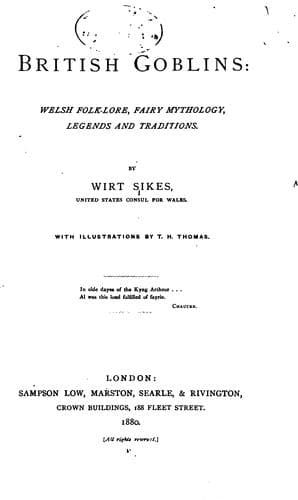
British Goblins: Welsh Folk-lore, Fairy Mythology, Legends and TraditionsSikes, Wirt
History
British Goblins: Welsh Folk-lore, Fairy Mythology, Legends and Traditions
Sikes, Wirt
Folklore -- Wales; Goblins -- Wales; Mythology, Celtic -- Wales; Mythology, Welsh; Wales -- Social life and customs
at the mouth of the Ogof a figure well-known to the shepherd by
remembrance. It was dimly visible; but it was Iolo ap Hugh, one could
see that at once. He was capering madly to the music of his own
fiddle, with a lantern dangling at his breast. 'Suddenly the moon
shone full on the cave's yellow mouth, and the shepherd saw poor Iolo
for a single moment--but it was distinctly and horribly. His face was
pale as marble, and his eyes stared fixedly and deathfully, whilst his
head dangled loose and unjointed on his shoulders. His arms seemed to
keep his fiddlestick in motion without the least sympathy from their
master. The shepherd saw him a moment on the verge of the cave, and
then, still capering and fiddling, vanish like a shadow from his
sight;' but the old man was heard to say he seemed as if he slipped
into the cave in a manner quite different from the step of a living
and a willing man; 'he was dragged inwards like the smoke up the
chimney, or the mist at sunrise.' Years elapsed; 'all hopes and
sorrows connected with poor Iolo had not only passed away, but were
nearly forgotten; the old shepherd had long lived in a parish at a
considerable distance amongst the hills. One cold December Sunday
evening he and his fellow-parishioners were shivering in their seats
as the clerk was beginning to light the church, when a strange burst
of music, starting suddenly from beneath the aisle, threw the whole
congregation into confusion, and then it passed faintly along to the
farther end of the church, and died gradually away till at last it was
impossible to distinguish it from the wind that was careering and
wailing through almost every pillar of the old church.' The shepherd
immediately recognised this to be the tune Iolo had played at the
mouth of the Ogof. The parson of the parish--a connoisseur in
music--took it down from the old man's whistling; and to this day, if
you go to the cave on Hallow eve and put your ear to the aperture, you
may hear the tune 'Ffarwel Ned Pugh' as distinctly as you may hear the
waves roar in a sea-shell. 'And it is said that in certain nights in
leap-year a star stands opposite the farther end of the cave, and
enables you to view all through it and to see Iolo and its other
inmates.'[49]
[Music: FFARWEL NED PUGH.]
FOOTNOTE:
[49] 'Camb. Quarterly,' i., 45.
CHAPTER VIII.
Fairy Rings--The Prophet Jones and his Works--The Mysterious
Language of the Tylwyth Teg--The Horse in Welsh
Folk-Lore--Equestrian Fairies--Fairy Cattle, Sheep, Swine,
etc.--The Flying Fairies of Bedwellty--The Fairy Sheepfold
at Cae'r Cefn.
I.
Public-domain text, read in full here on John Shaqi.
Reviews
Reviews
No reviews yet
Be the first to share your thoughts on this work.
Elsewhere in the archive
Join the Discussion
Join the discussion
Sign in to leave a comment or review.
Sign InorCreate an account