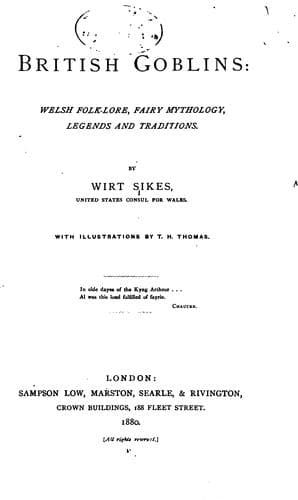
British Goblins: Welsh Folk-lore, Fairy Mythology, Legends and TraditionsSikes, Wirt
History
British Goblins: Welsh Folk-lore, Fairy Mythology, Legends and Traditions
Sikes, Wirt
Folklore -- Wales; Goblins -- Wales; Mythology, Celtic -- Wales; Mythology, Welsh; Wales -- Social life and customs
The circles in the grass of green fields, which are commonly called
fairy rings, are numerous in Wales, and it is deemed just as well to
keep out of them, even in our day. The peasantry no longer believe
that the fairies can be seen dancing there, nor that the cap of
invisibility will fall on the head of one who enters the circle; but
they do believe that the fairies, in a time not long gone, made these
circles with the tread of their tripping feet, and that some
misfortune will probably befall any person intruding upon this
forbidden ground. An old man at Peterstone-super-Ely told me he well
remembered in his childhood being warned by his mother to keep away
from the fairy rings. The counsel thus given him made so deep an
impression on his mind, that he had never in his life entered one. He
remarked further, in answer to a question, that he had never walked
under a ladder, because it was unlucky to walk under a ladder. This
class of superstitions is a very large one, and is encountered the
world over; and the fairy rings seem to fall into this class, so far
as present-day belief in Wales is concerned.
II.
Allusion has been made in the preceding pages to the Prophet Jones,
and as some account of this personage is imperatively called for in a
work treating of Welsh folk-lore, I will give it here, before citing
his remarks respecting fairy circles. Edmund Jones, 'of the Tranch,'
was a dissenting minister, noted in Monmouthshire in the first years
of the present century for his fervent piety and his large credulity
with regard to fairies and all other goblins. He was for many years
pastor of the congregation of Protestant Dissenters at the Ebenezer
Chapel, near Pontypool, and lived at a place called 'The Tranch,' near
there. He wrote and published two books, one an 'Account of the Parish
of Aberystruth,' printed at Trevecca; the other a 'Relation of
Apparitions of Spirits in the County of Monmouth and the Principality
of Wales,' printed at Newport; and they have been referred to by most
writers on folk-lore who have attempted any account of Welsh
superstitions during the past half-century; but the books are
extremely rare, and writers who have quoted from them have generally
been content to do so at second-hand. Keightley,[50] quoting from the
'Apparitions,' misprints the author's name 'Edward Jones of the
Tiarch,' and accredits the publication to 'the latter half of the
eighteenth century,' whereas it was published in 1813. Keightley's
quotations are taken from Croker, who himself had never seen the book,
but heard of it through a Welsh friend. It is not in the library of
the British Museum, and I know of but a few copies in Wales; the one I
saw is at Swansea. The author of these curious volumes was called the
Prophet Jones, because of his gift of prophecy--so a Welshman in
Monmouthshire told me. In my informant's words, 'He was noted in his
district for foretelling things. He would, for instance, be asked to
Public-domain text, read in full here on John Shaqi.
Reviews
Reviews
No reviews yet
Be the first to share your thoughts on this work.
Elsewhere in the archive
Join the Discussion
Join the discussion
Sign in to leave a comment or review.
Sign InorCreate an account